
The importance of “step-ancestors” - a case study
Today I am sharing the research I have undertaken on John Pethick, who is not directly related to me, but is the first husband of one of my ancestors, Mary Grace Cutmore. John disappeared from written records in 1851, and family lore states that he abandoned Mary Grace soon after, leaving her with several children to raise alone in rural colonial Australia. It can be easy to dismiss "step-ancestors" like John as irrelevant because they are not blood relations, but they are in fact an important part of family history research. This is especially true when researching female ancestors, who, thanks to patriarchal constructs, are frequently unrecorded, whereas their husbands are, and so we can trace their lives through the records of their husbands even if those husbands are not related to us. John's disappearance fundamentally shaped Mary Grace's life - she was left with several children to raise alone in difficult socio-economic circumstances, and later remarried my third great grandfather Benjamin Stanley, likely in part to provide for her children. Furthermore, her marriage to John would have naturally heavily shaped her experiences and the kind of life she lived, so it was important to me to research John Pethick, not just to find out what happened to him, but also to find out what happened to Mary Grace in the process.
I used a broad range of sources to research John Pethick. Because there were no matching death records for him on any Births, Deaths, and Marriages (BDM) registries in Australia, this suggests that his disappearance from the records was not simply due to his death. My goals for this research project were to find out anything I could about John Pethick from both before and after his disappearance so I could build up a clearer picture of his character to understand why he disappeared, and how this may have affected Mary Grace Cutmore.
For clarity's sake, I have ordered the information chronologically and listed each source in bold, with a description of what the source reveals about John Pethick, after which I will discuss what results, conclusions, and further research can be drawn from the project.
1. 6 April 1842, The Sydney Herald, p. 1. http://nla.gov.au/nla.news-article12874565.

This is a significant piece of evidence because it shows John Pethick was in business with the Cooper family. Further research into land records reveals that John Pethick had land with Cooper at Mony/Money Muk Creek, Wangelleck Creek, Bombala and Currawang (near Lake George), as well as Anembo at Gingera, mostly in the Monaro/Maneroo region of New South Wales. Further research indicates that many of these runs/properties were consolidated into big single properties in the 1860s onwards, which could be a reason why there is not much information available about them. More research is required to ascertain the specific locations of these properties, how long Pethick owned/leased them, how much of them he shared with the Coopers, and when he left/sold/lost them and why. A two part heritage study was done on Bombala Shire in 2018 and John Pethick is briefly mentioned in Part 1 as leasing a property at Wangelleck. It does not say exactly when this was, but circumstantial evidence suggests it was in the 1840s. [1]

Screenshot from the Bombala Heritage Study [see endnotes 1 and 2 for details.
The heritage studies also have lists of cemeteries in the area, but John Pethick does not appear to be listed in any of them [2]. However, many of those cemeteries are in disrepair and the paddocks they are in have been returned to sheep grazing, with the headstones removed to another location or stacked together on a part of the property. It is therefore possible that John Pethick may indeed be buried there and his grave later damaged, but for that to be the case there should also be a death or burial record for him. However there are none listed under his name (or any variant names) in any Australian BDM registries or in the Ryerson’s index for death notices and obituaries in Australian newspapers (https://www.ryersonindex.org/).
2. 8 April 1844, The Sydney Morning Herald, p. 3. http://nla.gov.au/nla.news-article12412138
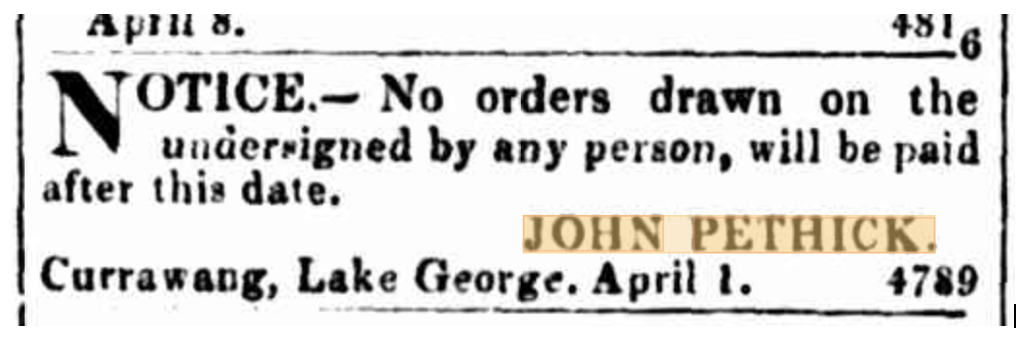
This notice was published a year before John Pethick married Mary Grace Cutmore in 1845, and signifies a consistent theme throughout later records and newspaper notices of his struggles with financial difficulties.
3. 10 April 1844, The Sydney Morning Herald, p. 1. http://nla.gov.au/nla.news-article28650800
Same as above.
4. 9 April 1844 The Sydney Morning Herald), p. 1. http://nla.gov.au/nla.news-article12412491
Same as above.
5. 2 February 1847, New South Wales Government Gazette, p. 139. http://nla.gov.au/nla.news-article230674322
John Pethick’s partnership with Robert Cooper junior is dissolved.
21 April 1848, New South Wales Government Gazette, p. 536. http://nla.gov.au/nla.news-article230130762
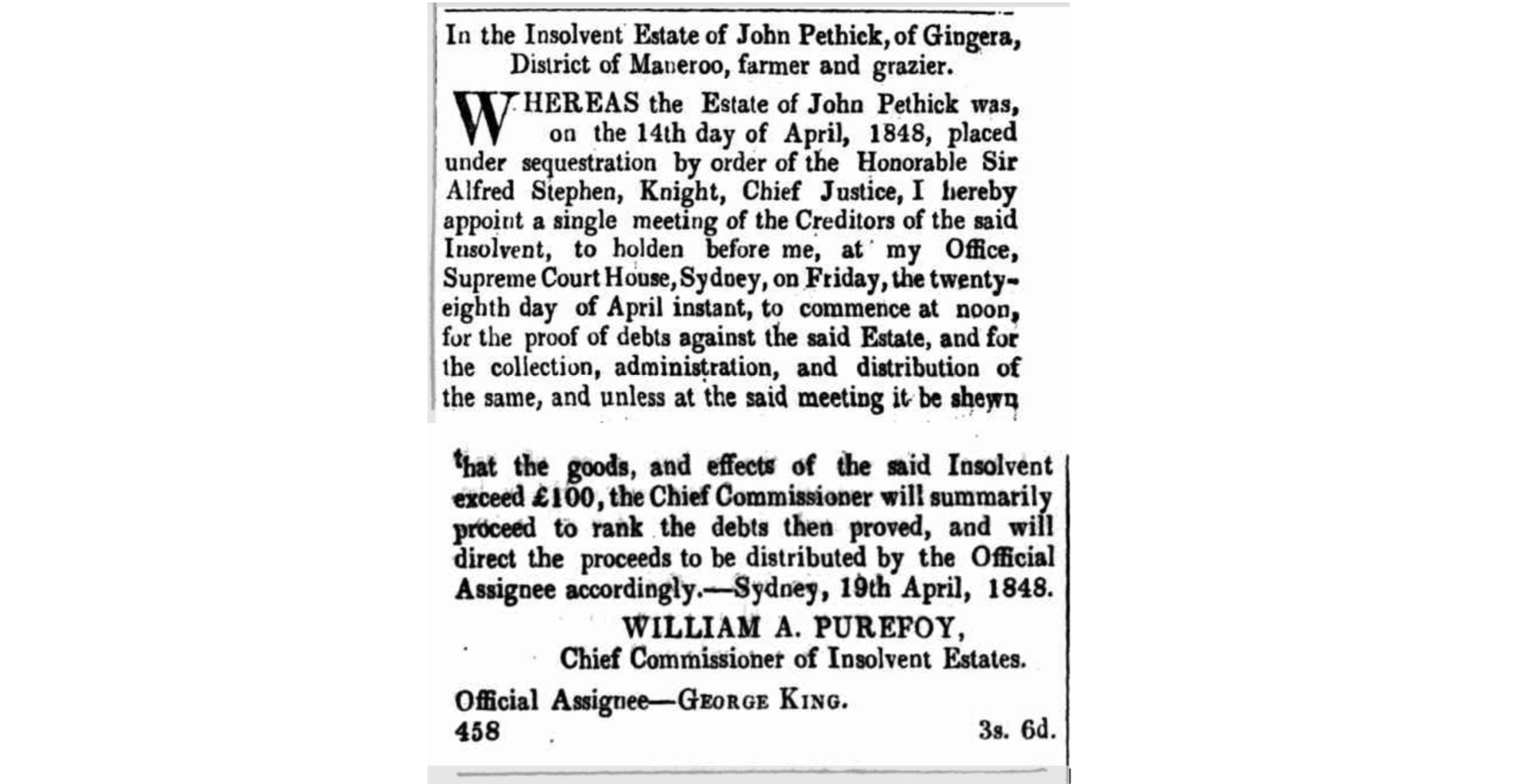
This is another significant piece of evidence that reveals John Pethick was declared insolvent in 1848. He disappears from written records only a three years later, c.1851. He may have been trying to outrun debts, or, as other evidence (see below) suggests, he may have left to try to recover his fortune on the goldfields. Regardless, this notice shows that John Pethick did have a motive to disappear from the written records. He may have also changed his name to build a new reputation or outrun debts.
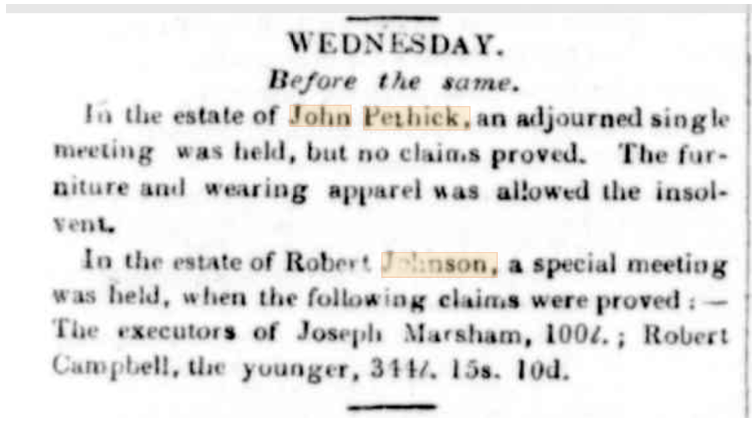
18 May 1848, Sydney Chronicle, p. 3. http://nla.gov.au/nla.news-article31756701
This notice related to the 21 April 1848 notice where John Pethick is declared insolvent, and reveals that he was allowed to keep his furniture and apparel. This would unquestionably affected Mary Grace Cutmore as she lost her home (and thus her lifestlye) by consequence of John’s insolvency.
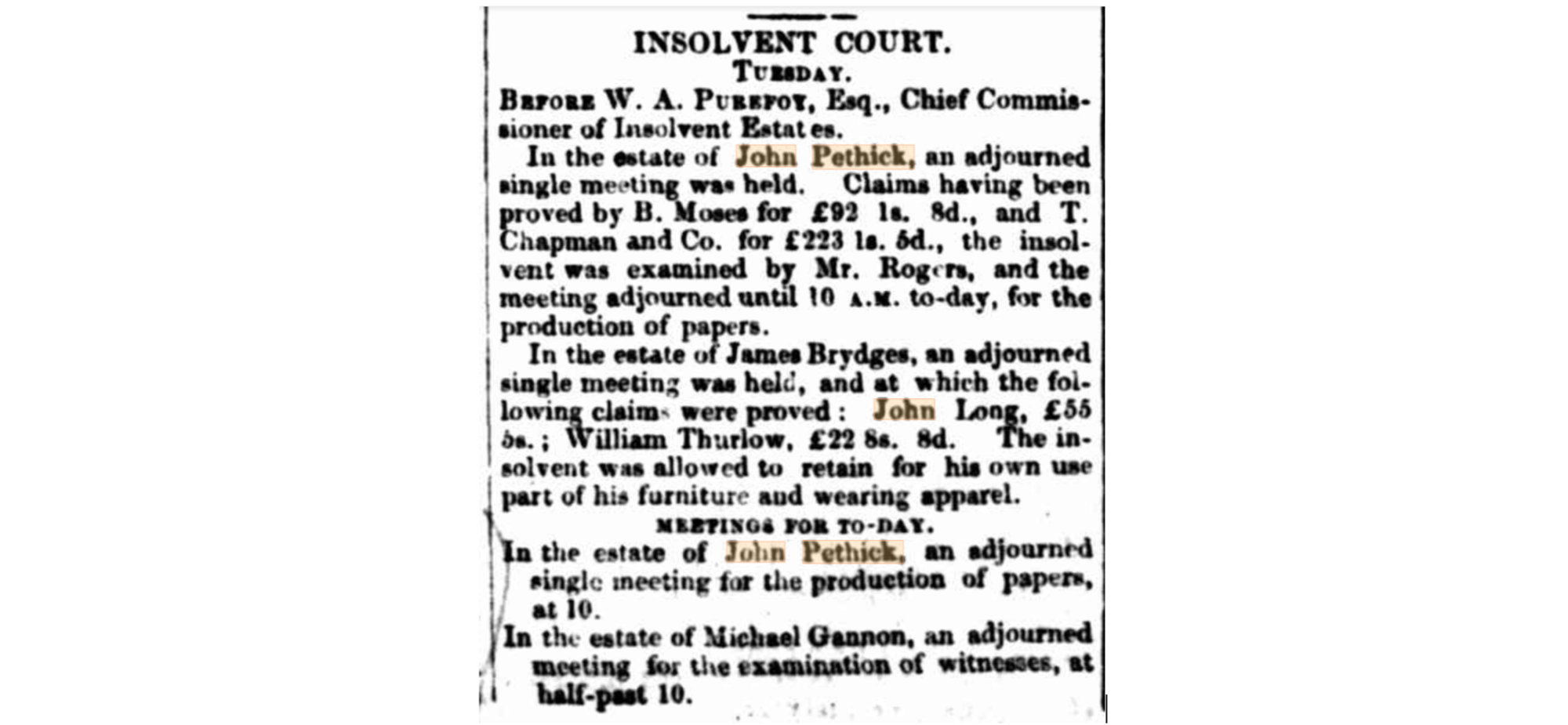
10 May 1848, ‘Insolvent Court’, The Sydney Morning Herald, p.2 http://nla.gov.au/nla.news-article12911927
This notice details John Pethick’s debts, or at least what people claimed he owed them; a large amount of money during this period.
1 February 1851, ‘Advertising’ The Goulburn Herald and County of Argyle Advertiser, p. 7. http://nla.gov.au/nla.news-article101732973
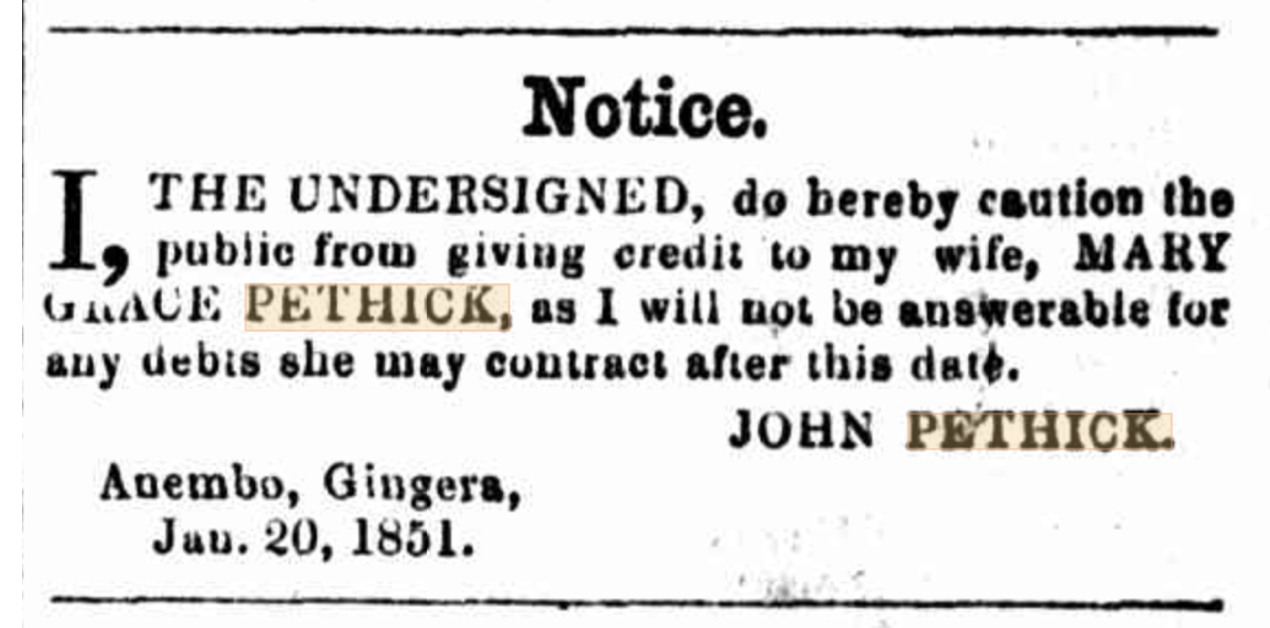
This is the most important record in this research project because John Pethick states his location (Anembo, Gingera) and mentions Mary Grace Cutmore, confirming that it is the relevant John Pethick in all the other newspaper advertisements. It also indicates that John was able to remain at least one of his properties. This advertisement also provides an insight into the relationship between Mary Grace and John Pethick. Although John Pethick implicitly depicts Mary Grace as the person at fault in this situation, there were likely other complexities at play, especially considering that John had been declared insolvent and heavily indebted just three years earlier. As always, it is important to examine both sides/aspects of a record like this, and take an objective viewpoint informed by an understanding of the social, political and gendered aspects of the record’s historical context. For example, Mary Grace may have simply been making purchases on credit to be able to feed and clothe her family, as it could be very difficult for married women to maintain financial independence during this period. It is also possible that John and Mary separated, and John did not want to be answerable for her debts.
This advertisement is also the last confirmed “sighting” of John Pethick before he disappears from written records apart from the birth and death of his and Mary’s son William in 1852, although it is certainly possible that John could have disappeared before then.
22 March 1851, ‘Larceny’, The Goulburn Herald and County of Argyle Advertiser p. 4. http://nla.gov.au/nla.news-article101733177
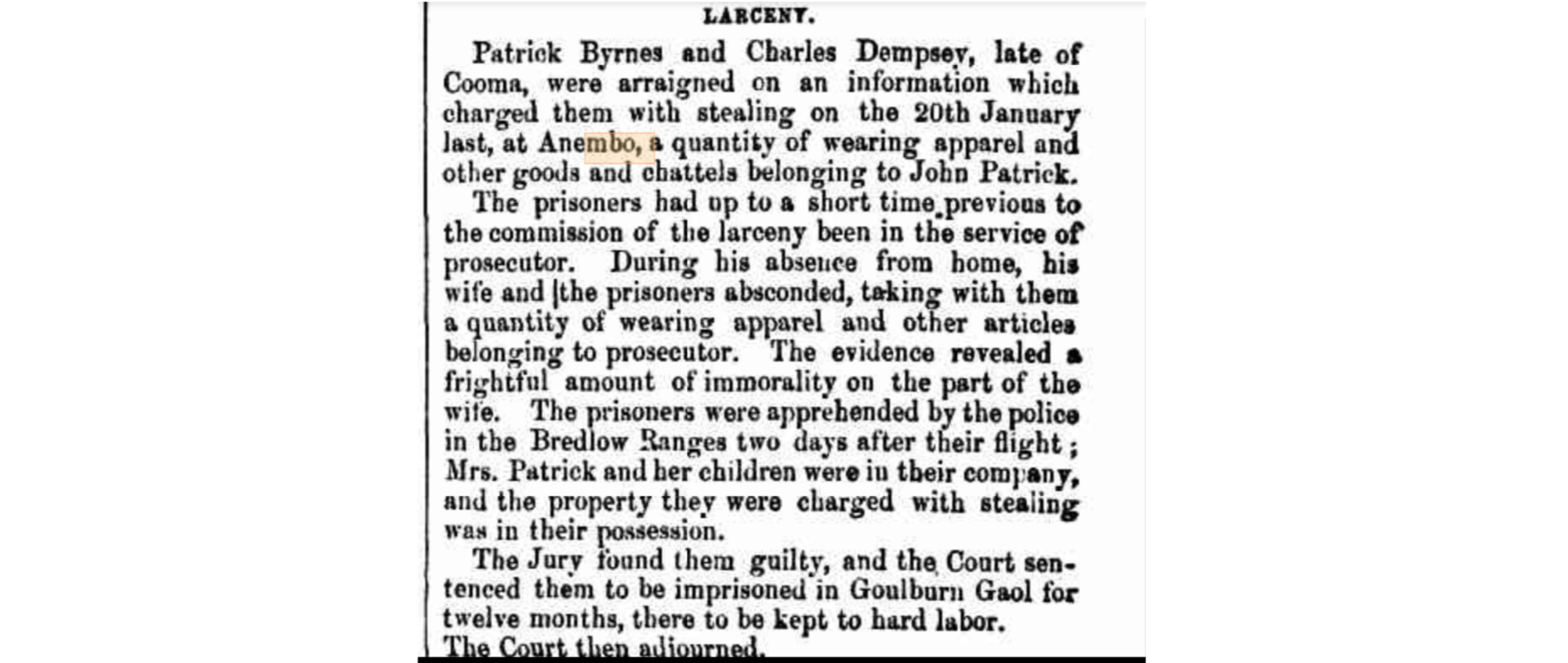
It is unclear whether this article is referring to John Pethick and Mary Grace Cutmore. Patrick is somewhat similar to Pethick and could be a misprint or mistake. The fact that the property is at Anembo does weigh in that favour, as does the fact that the article was printed only a few months after John Pethick advises the public not to give credit to Mary Grace. If it is John Pethick and Mary Grace Cutmore, it sheds an important light on their marriage, indicating that Mary Grace was unhappy enough in their marriage to be willing to “steal” from John and flee with her children and two other men who he used to employ. The wife and children would likely have been forced to return to the husband in any case. I also researched whether there was a “John Patrick” living in the Anembo area at the time, but there does not appear to be. Further research into legal/court records for this case is required, as is research into any possible employment records (or property/land/census records) for Byrnes and Dempsey to see if they were employed by John Pethick. It is also necessary to research in Simpson Davisson’s book (see below) to see whether it mentions that John was away from home during this time as the newspaper notice states.
The Gold Deposits in Australia: Their Discovery, Development and Geognosy, with a Disquisition on the Origin of Gold in Placer-deposits and in Quartz-veinstones by Simpson Davison, 1861 [3].
Excerpts of this book that mention John Pethick have appeared in newspapers, but the book itself contains a much clearer, more detailed account. Essentially, evidence from the book reveals that Simpson Davison was an associate of Edward Hargraves who found payable gold in NSW and thus ignited the Australian Gold Rush in May 1851. The book reveals that Simpson Davison was a neighbour of John Pethick, and recommended him as a man of “sterling honesty” whom Edward Hargraves should make his confidant.
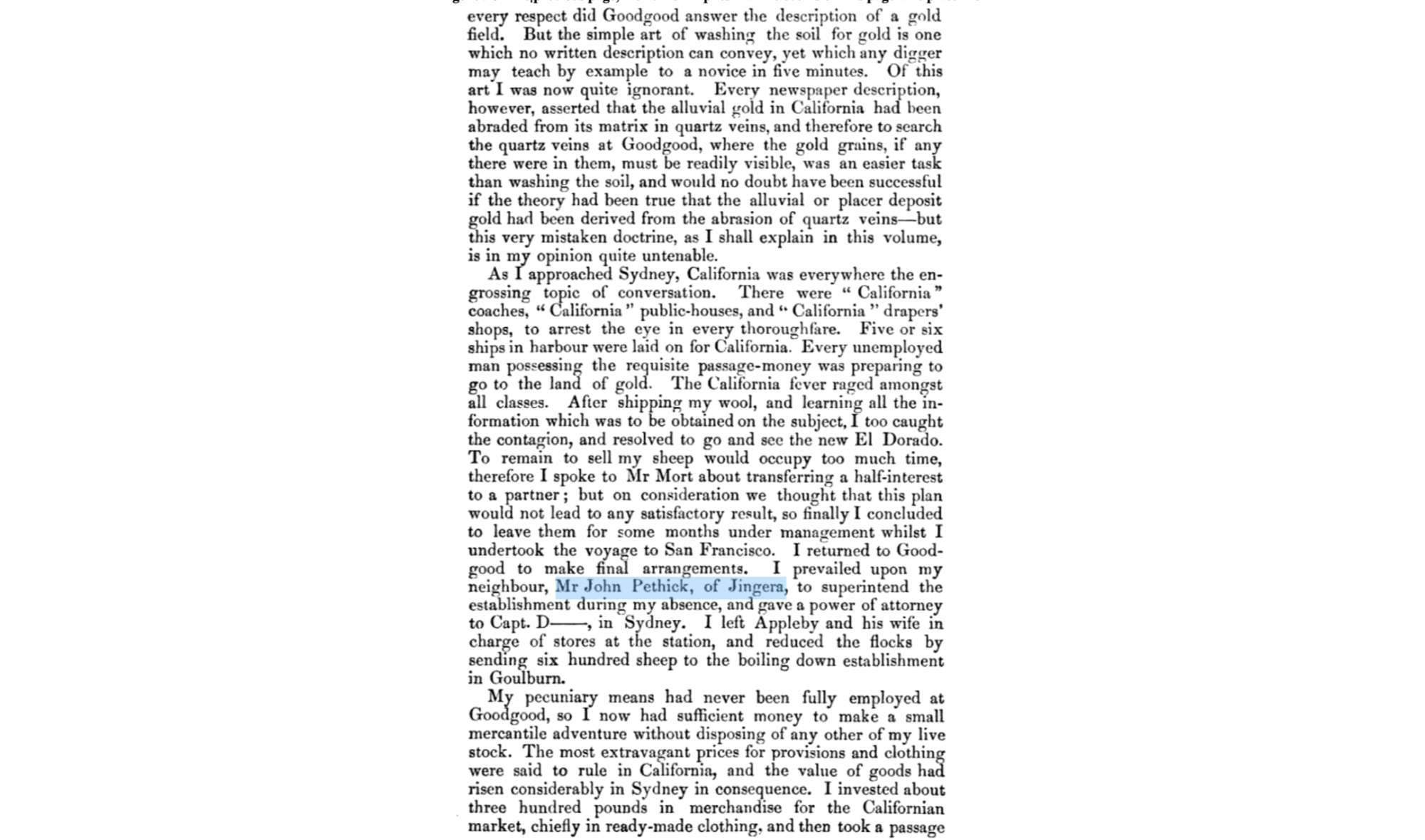
The Gold Deposits in Australia by Simpson Davison, p. 29. Note: On the previous page, the author implies that the events on this page take place around 1849, further indicating that John Pethick was still at Anembo, Jingera/Gingera at that time.
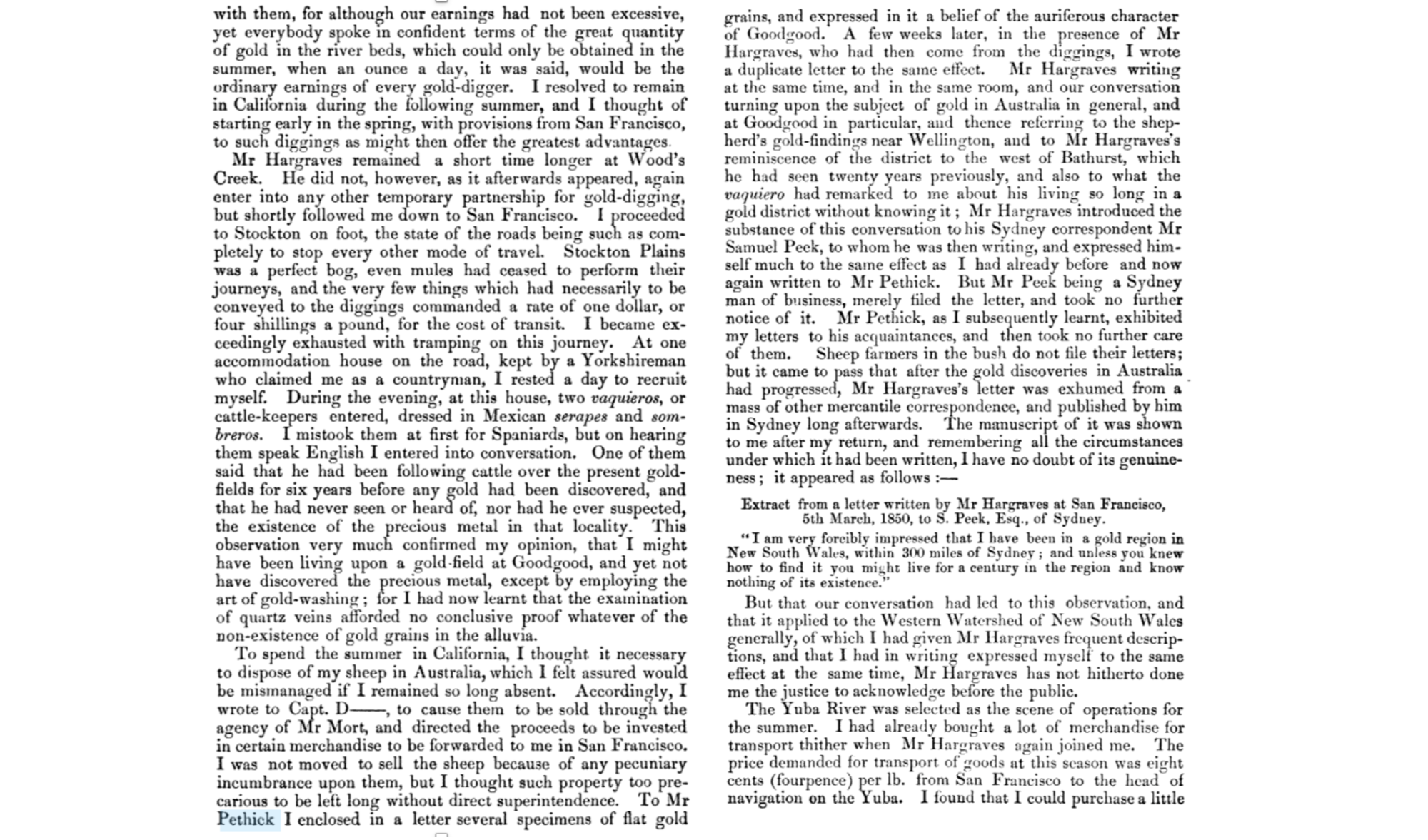
Pages 41-42. On page 30 of the book, the author implies (though quite vague) that the page also takes place around 1849
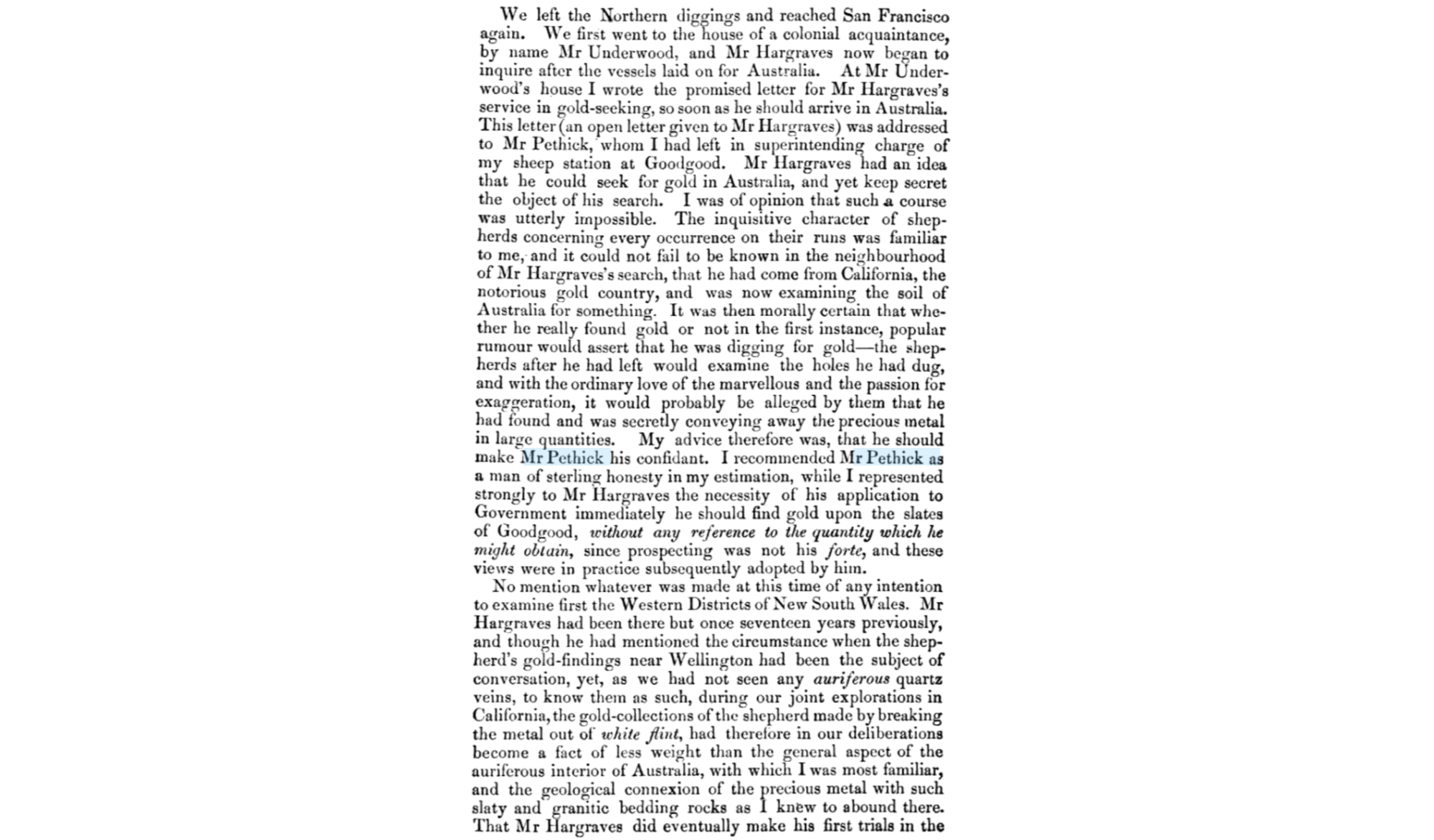
Page 53. It is unclear when the events on this page take place, but must be before 1851, when Hargraves finds gold in NSW.
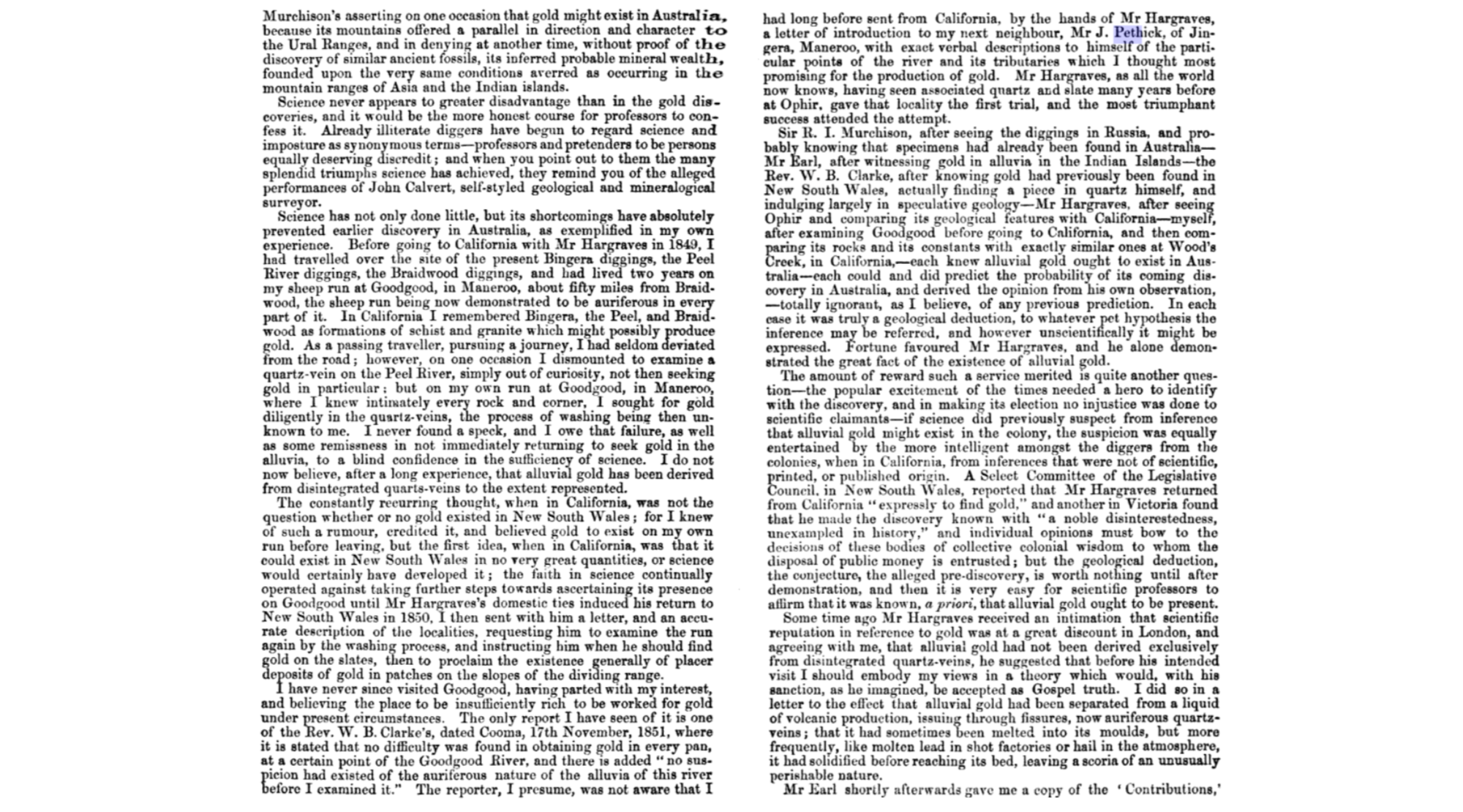
Page 145. Hargraves likely returned to Australia with the letter circa 1850-51.
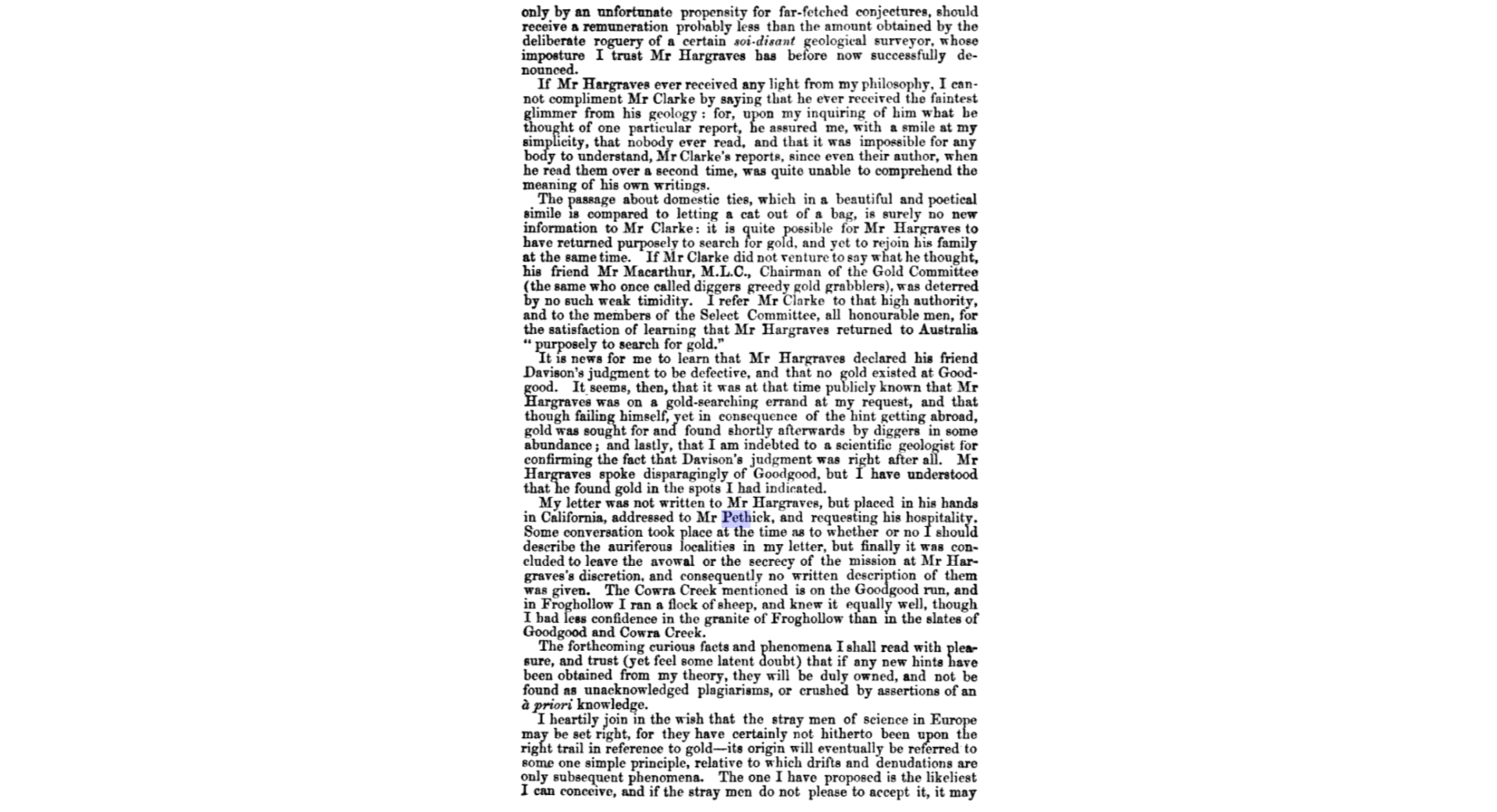
Page 164. Again, the date of these events is clear but likely around 1850-51. It’s interesting to note that Simpson Davison entrusts Hargraves with a letter for John Pethick, requests John Pethick’s hospitality, and mentions that Edward Hargraves was disparaging about Good Good (that apparently adjoined John Pethick’s property at Gingera) but that gold was eventually found there.
15 April 1854, The Maitland Mercury and Hunter River General Advertiser, p. 2. http://nla.gov.au/nla.news-article688151
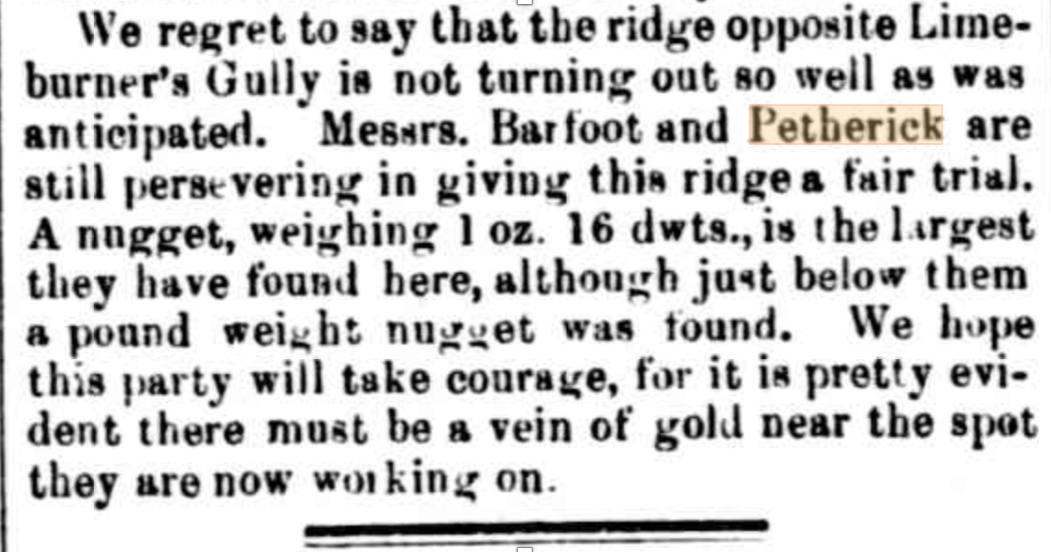
This article from a correspondent in the Northern Goldfields mentions a Messrs Barfoot and Petherick. Petherick sounds phoenitically similar to Pethick and could be a misprint, a name change, or the correspondent may have misheard/misremembered his name. Because John Pethick disappears from written records after 1851 and was declared insolvent a few years before that, along with the articles and book excerpts about John Pethick’s close association with Edward Hargraves and the beginning of the gold rush, it could be possible that John Pethick disappeared to the goldfields. The Gold Rush began in May 1851 after Edward Hargraves found payable gold near Orange, NSW, a few months after we last hear of John Pethick. Pethick may have left to find his fortune on the goldfields and never returned, perhaps starting a new life or dying while on the gold fields - disease and accidents were rife during the Gold Rush. This same article is repeated several times in other newspapers and a later article says the two “young men” (Barfoot and Petherick) did succeed in opening a large shaft and finding gold. John Pethick was about 32-33 years old at the time, so he fits this description. No further information about these two men appeared in my research. [4].
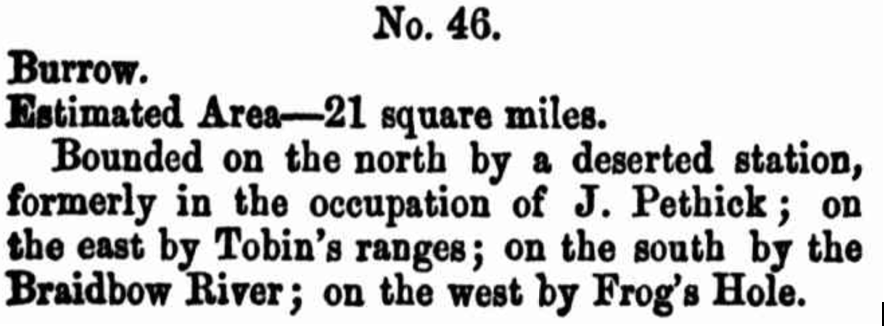
23 January 1856, ‘ADJUSTED, FORFEITED, AND VACATED RUNS.’ New South Wales Government Gazette, p. 202. http://nla.gov.au/nla.news-article228680627
The property here is described as neighbouring a deserted station formerly occupied by J Pethick. This is very like to be our John Pethick because Simpson Davison mentions that Frog’s Hollow is near John Pethick’s property. This indicates that John vacated his property (either due to leaving or dying) before this date. But if John Pethick vacated his property, where did Mary Grace Cutmore and their children go? Family lore, and the fact that Mary Grace remained in the region after John Pethick’s disappearance suggests that she did not go with him. Until her marriage to Benjamin Stanley two years later, Mary Grace would have had to support her children by herself as a single mother in mid-nineteenth century rural Australia.
25 April 1857, ‘Advertising’, The Goulburn Herald and County of Argyle, p. 1. http://nla.gov.au/nla.news-article118307832

This article is incredibly significant as it indicates that John Pethick must have died before April 1857. Because Mary Grace Cutmore married Benjamin Stanley in 1855, in the same town in which she married John Pethick, it is very likely that John died before 1855 for Mary Grace to not be charged with bigamy. It is of course possible that Mary Grace and/or the community believed that John was dead when he wasn’t, but in any case he should have a death certificate/record, of which there is none.
Research Results and Conclusions:
The goals of this research project have been met. I now have a much clearer understanding of John Pethick’s character and the circumstances that may have influenced his disappearance. His consistent difficulties with debt and insolvency combined with his association with key figures of the Australian Gold Rush gives him a clear motive to disappear, either to the goldfields or to another location.
There are no death records listed under John Pethick or any other spelling variant of this name. Indeed, I even searched for only the surname “Pethick” (and many other alternate spellings) but no records that could match him were listed. There are of course other John Pethicks who died during this era, but careful examination of their death records reveal that they are not the John Pethicks I am searching for.
Although what happened to John Pethick after his disappearance is ambiguous, the results of this research project provide several highly plausible possibilities and open up new avenues of research. For example, the research indicates that John’s disappearance is very likely linked to seeking gold due to his association with key figures of the Gold Rush. It is possible that John died on the goldfields and his name was unrecorded on his death record because no one knew who he was, but given his close association with the key figures of the Gold Rush this is unlikely. Because of John’s history of financial difficulties, it is also possible that he left New South Wales to start afresh, but no confirmed records of him appear to exist in other states. Alternately, he may have tried to outrun any debts and start afresh by leaving Australia and returning to the British Isles; Simpson Davison’s travels in America could also point to John immigrating to the American goldfields. More research into immigration records is needed to test both of these possibilities.
In any case, John was clearly dead, or presumed dead, by 1857, as the article about Foxlow’s store confirms. As previously mentioned, because Mary Grace Cutmore married Benjamin Stanley in 1855, in the same town in which she married John Pethick, it is very likely that John died or was presumed dead before this date for Mary Grace to not be charged with bigamy. Mary Grace may also have been able to remarry under the fact that John’s disappearance could be classed as desertion - more research into this is needed.
Another goal of this research project was to demonstrate the value of researching “step-ancestors”. By researching John Pethick, even though he is not related to me, I have been able to gain many insights into the life of Mary Grace Cutmore. Her marriage to John was clearly complex and difficult, and through John’s debts and insolvency Mary Grace would have experienced a wide range of circumstances, from relative prosperity to only being able to retain furniture and wearing apparel. The newspaper notice from 1 February 1851 also suggests that, like many other married women during this period, she had little financial independence. If the newspaper notice from 22 March 1851 is relevant to her, it also reveals that her marriage to John was difficult enough that she was willing to take significant risks for herself and her children to leave him. John’s disappearance would have had an enormous affect on her life, and until her remarriage to Benjamin Stanley about four years later, she would have had to raise and provide for her children alone as a single mother in difficult conditions.
I look forward to sharing more research into the Cutmore/Pethick/Stanley family tree in the future.
Best wishes,
Liliana
_________________________
[1] & [2] Citation details for the two heritage studies:
Giovanelli and O’Keefe, ‘Bombala Shire Area Heritage Study Volume 1 - Report’, Snowy Monaro Regional Council, August 2018, https://ehq-production-australia.s3.ap-southeast-2.amazonaws.com/4a51014b26f601caaa1e5b912d75ae6ebe74acf5/original/1602457994/Appendix_E_-_BombalaShireAreaHeritageStudy_REPORT.pdf_45718cbd8bce389ef8480a8ddbd92a06?X-Amz-Algorithm=AWS4-HMAC-SHA256&X-Amz-Credential=AKIA4KKNQAKIII4DU7AG%2F20260212%2Fap-southeast-2%2Fs3%2Faws4_request&X-Amz-Date=20260212T220914Z&X-Amz-Expires=300&X-Amz-SignedHeaders=host&X-Amz-Signature=2ed034fdbbef1fe83839992b35c0cc1427818d493901945bcd4666cc638adff0 .
Giovanelli and O’Keefe, ‘Bombala Shire Area Heritage Study Volume 2 - INVENTORY’, Snowy Monaro Regional Council, August 2018, https://ehq-production-australia.s3.ap-southeast-2.amazonaws.com/f863221991ec663ba2e6712b1cf0eb32bb00a52d/original/1602458011/Appendix_D_-_BombalaShireAreaHeritageStudy_INVENTORY.pdf_35784303b5da339a62292dd60a4ad420?X-Amz-Algorithm=AWS4-HMAC-SHA256&X-Amz-Credential=AKIA4KKNQAKIII4DU7AG%2F20260212%2Fap-southeast-2%2Fs3%2Faws4_request&X-Amz-Date=20260212T220857Z&X-Amz-Expires=300&X-Amz-SignedHeaders=host&X-Amz-Signature=f93f147af290546049629cfc031f6cf74dcdb868a9f49a0896ec187bc1f296c4 .
[3] This book is available online for free at both Archive.org and Google Books.
[4] Citation details: 11 March 1854, ‘The Northern Gold Fields’, The People's Advocate and New South Wales Vindicator, p.7, http://nla.gov.au/nla.news-article251545206.