
Objects of the Gold Rush…
Examining objects and material culture are important ways in which we can understand the past and how our ancestors lived in it. This is especially true when discussing the Australian Gold Rush, where tools were vital objects to miners. Indeed, without tools, the Gold Rush would certainly not have been possible. In this blog post, I discuss deep lead mining in the Ballarat region (a key epicentre of gold mining during the Gold Rush) through examining three tools that the miners used. These objects provide powerful insights into the experiences of deep lead gold miners in the Ballarat/Buninyong region during the 19th century.
The Victorian Gold Rush began in 1851 when gold was discovered at Ballarat, and thousands of people from diverse backgrounds soon flocked to Ballarat and surrounding areas to search for gold. The Gold Rush dramatically transformed Victoria’s society and enriched its economy, but also wrought destruction upon landscapes and waterways, and further dispossessed Indigenous groups. As mining technologies and techniques progressed, Ballarat became a pioneer of deep lead (pronounced “leed”) mining, which triggered Ballarat’s second gold rush in 1852. Although deep lead mining in Ballarat fell into decline during the 1870s, the area remained a centre of gold mining throughout the latter half of the 19th century, and gold is still mined there today. During the heyday of deep lead gold mining in Ballarat, over a thousand men worked in the mines in cramped, dark, and dangerous conditions, and used a variety of tools to mine gold.
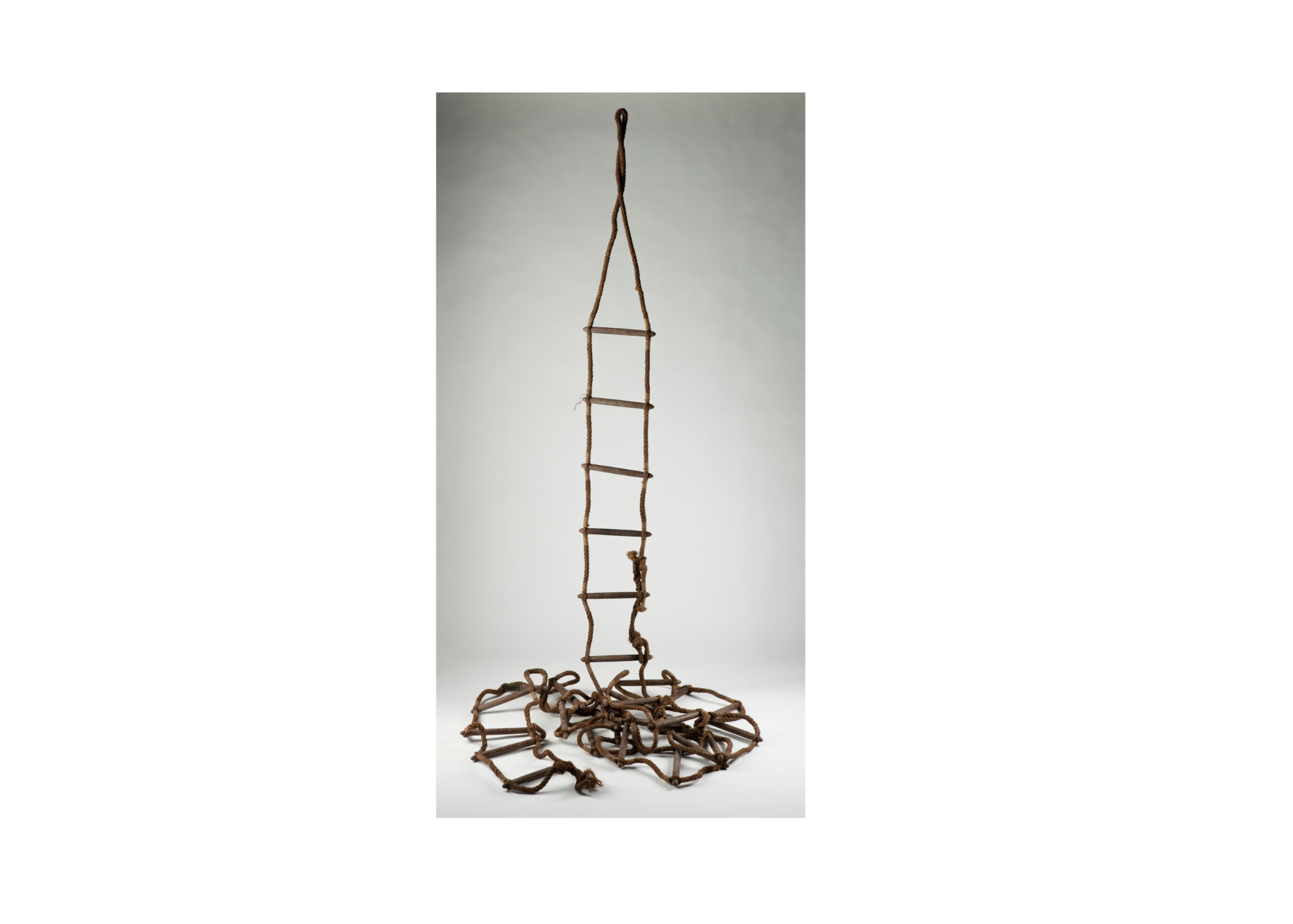
‘Mine rope ladder, Buninyong’, maker unknown, c. late 19th century, National Museum of Australia, Victorian Goldfields collection no. 1, 2011.0032.0002.
The first object in this blog post is a mining ladder that was used in deep lead gold mining – a complicated process where miners sunk a shaft into the earth and then created tunnels to access gold-bearing gravels in ancient underground streambeds (called “leads”). Deep lead mining was developed by innovative Scottish, Welsh, and Cornish miners, who formed a significant percentage of Ballarat’s population. Although the reward of gold could be great, deep lead mining was a dangerous process, and cave-ins, flooding, falling rocks, and toxic carbon dioxide were an everyday threat to miners. The length of ladders like this one are a rare insight into just how far underground miners were prepared to go to find gold.
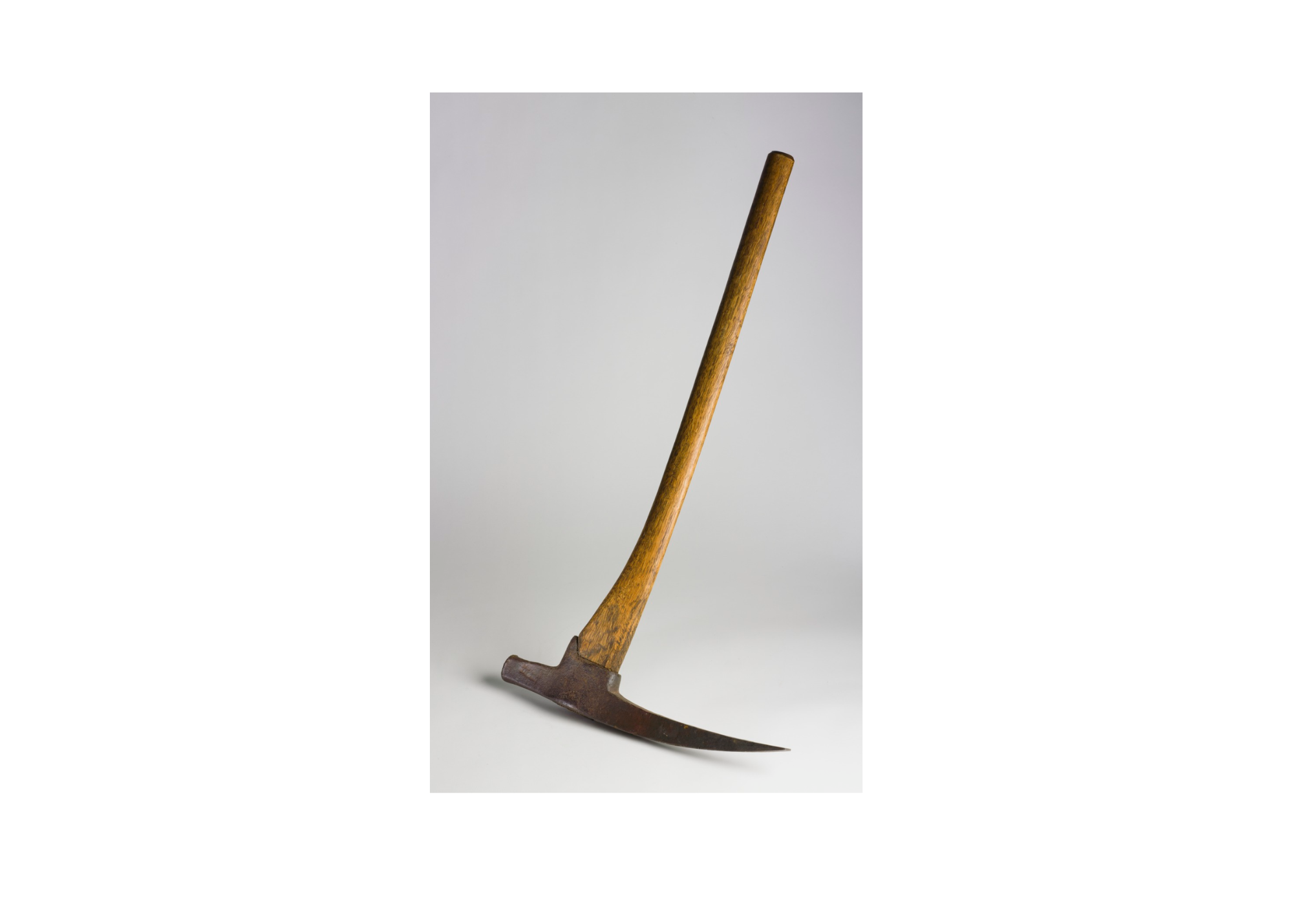
‘Gold miner's pick with initals 'JLR', Ballarat’, maker unknown, c. late 19th century, National Museum of Australia, Victorian Goldfields collection no. 1, 2011.0032.0003.
The second object, shown above, is a pick, which was an important tool used by deep lead miners, especially when they dug mine shafts. This was a backbreaking and sometimes months-long process. Miners had to dig through layers of hardened lava deposits and sediments, and the point on the end of this pick shows just how sharp their tools needed to be - in the Ballarat/Buninyong region, some shafts were over 90 metres deep. This pick has the word “maker” and the initials “J L R” carved upon it. Although it is uncertain who “J L R” was, this pick nonetheless symbolises the long and difficult process it took for miners to create a deep lead gold mine.
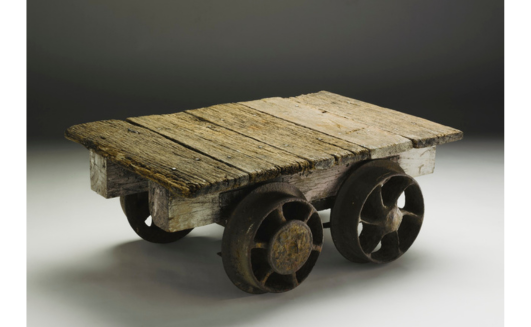
‘Flat-top mining cart’, maker unknown, c. late 19th century, National Museum of Australia, Victorian Goldfields collection no. 1, 2011.0032.0001.
The third and final object in this blog post is a mining cart, used by miners deep underground. When deep lead mining was introduced, miners soon realised that it was too difficult to do alone. This led to the formation of mining companies, who employed dozens, or sometimes hundreds, of men to work in a mine for a wage, or in exchange for a percentage of the gold they found. Despite the technologies and infrastructure of company-owned mines, deep lead mining was still gruelling work in cramped, dark tunnels. However, carts like this one made it easier for miners to transport the potentially gold-bearing gravel so it could be processed and the miners could get their gold or their wage.
Researching objects and material culture is a significant part of my work as both a historian and family historian. The objects examined in this blog post are a compelling example of how objects help us to understand history on an individual, micro level. Records can only reveal so much, but together with material culture they can yield powerful insights into events like the Gold Rush and its far-reaching impacts on landscape and human life during both this pivotal time in Australia’s settler-colonial history and the present day.
______________________________
BIBLIOGRAPHY
PRIMARY SOURCES
‘A Neglected Deep Lead’, The Age,10 September 1896, p. 7.
‘Flat-top mining cart’, maker unknown, c. late 19th century, National Museum of Australia, Victorian Goldfields collection no. 1, 2011.0032.0001.
‘Gold miner's pick with initals 'JLR', Ballarat’, maker unknown, c. late 19th century, National Museum of Australia, Victorian Goldfields collection no. 1, 2011.0032.0003.
‘Mine rope ladder, Buninyong’, maker unknown, c. late 19th century, National Museum of Australia, Victorian Goldfields collection no. 1, 2011.0032.0002.
‘Safety Appliances at Mines’, The Ballarat Courier, 23 January 1884, p. 4, http://nla.gov.au/nla.news-article262613433.
SECONDARY SOURCES
‘Gold’, Resources Victoria (1 December 2021), https://resources.vic.gov.au/geology-and-data/minerals/metals/gold.
‘Health on the goldfields: Surviving the Ballarat gold rush’, Sovereign Hill (25 June 2025), https://www.sovereignhill.com.au/stories/health-on-the-goldfields-surviving-the-gold-rush/.
‘History of gold mining in Victoria’, Resources Victoria (2 June 2021), https://resources.vic.gov.au/geology-and-data/minerals/metals/gold/gold-mining-in-victoria.
‘Our Mine: Ballarat’, Victory Minerals (n.d.), https://ballaratgoldmine.com.au/our-mine/.
‘Victorian Goldfields Project. Historic Gold Mining Sites in The Ballarat City Goldfield. Preliminary Report on Cultural Heritage’ (draft) and ‘Victorian Goldfields Project. Historic Gold Mining Sites in the Ballarat Goldfield Site. Gazetteer’, Ballarat City, Department Of Natural Resources & Environment, December 1999, accessed as a pdf file via Heritage Victoria.
Bannear, David, ‘Mining Technology: Overview’, eGold [Electronic Encyclopedia of Gold in Australia] (n.d.), https://www.egold.net.au/biogs/EG00009b.htm.
Cardell, Kerry et al, ‘Welsh Identity on the Victorian Goldfields in the Nineteenth Century’, in Kerry Cardell and Cliff Cumming, eds., A World Turned Upside Down: Cultural Change on Australia's Goldfields 1851-2001 (Canberra 2001), pp. 25-60, http://hdl.handle.net/1885/210329.
Cardell, Kerry, and Cliff Cumming, ‘Squatters, Diggers and National Culture: Scots and the Central Victorian Goldfields 1851-61’, in Kerry Cardell and Cliff Cumming, eds., A World Turned Upside Down: Cultural Change on Australia's Goldfields 1851-2001 (Canberra 2001), pp. 77-114, http://hdl.handle.net/1885/210329.
Croggan, Jan, ‘Methodists and Miners: The Cornish in Ballarat 1851-1901’, in Kerry Cardell and Cliff Cumming, eds., A World Turned Upside Down: Cultural Change on Australia's Goldfields 1851-2001 (Canberra 2001), pp. 61-76, http://hdl.handle.net/1885/210329.
Davey, Christopher Jay, ‘The origins of Victorian mining technology, 1851 – 1900’, The Artefact, vol.19 (1996), pp. 52-62.
Davey, Christopher Jay, and P. L. McCarthy, ‘The Development of Victorian Gold-Mining Technology’, Victorian Historical Journal, Vol. 73, No. 1 (2002), pp. 64-92.
Davine, Anna, ‘Ballarat, VIC’, eGold [Electronic Encyclopedia of Gold in Australia] (n.d.), https://www.egold.net.au/biogs/EG00245b.htm.
Goodman, David, “The Gold Rushes of the 1850s.” in Alison Bashford and Stuart Macintyre, eds., The Cambridge History of Australia Volume 1 (Cambridge 2013), pp. 170-188.
Haughie, Robt, ‘How these Mines worked’, Buried Rivers of Gold (n.d.), https://www.buriedriversofgold.org/the-mines.
Haughie, Robt, ‘The Dark Labyrinth’, Buried Rivers of Gold (n.d.), https://www.buriedriversofgold.org/the-dark-labyrinth.
Leslie, W. D., and A. J. Holland, ‘Tribute Agreements’, Australian Mining and Petroleum Law Association bulletin, Vol.1 (1) (n.d.), accessed via the Australasian Legal Information Institute, https://www.austlii.edu.au/au/journals/AUMPLawB/1982/3.pdf.
Parks Victoria, ‘Deep Lead Mining Plant’, eGold [Electronic Encyclopedia of Gold in Australia] (n.d.), https://www.egold.net.au/biogs/EG00036b.htm.
Parks Victoria, ‘Underground Deep Lead Mining’, eGold [Electronic Encyclopedia of Gold in Australia] (n.d.), https://www.egold.net.au/biogs/EG00035b.htm.
Reeves, Keir, ‘Telling the National Story of Gold’, eGold [Electronic Encyclopedia of Gold in Australia] (n.d.), https://www.egold.net.au/biogs/EG00074b.htm.
Waldron, David, Kelly Ann Blake, and Shannen Mennen, ‘In the 1800s, colonial settlers moved Ballarat’s Yarrowee River. The impacts are still felt today’, The Conversation (3 November 2023), https://theconversation.com/in-the-1800s-colonial-settlersmoved-ballarats-yarrowee-river-the-impacts-are-still-felt-today-214949.