
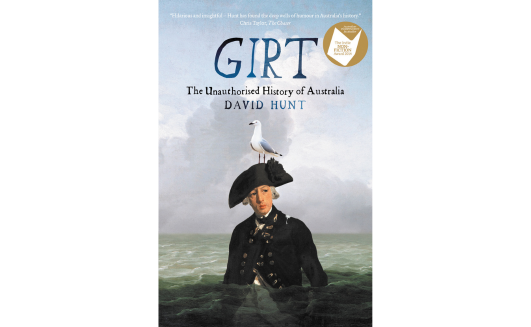
Book Review: Girt by David Hunt.
Trigger Warning: this blog post discusses racism and the atrocities committed by settler-colonists against Australian Indigenous peoples, including the theft of Ancestral remains. If this is a triggering or difficult topic for you, please do whatever is right for your mental health - you matter.
Australian history is complex, and, at times, somewhat absurd. In Girt: The Unauthorised History of Australia, David Hunt sheds light on forgotten or ignored aspects of Australia’s history, highlighting the funny, absurd and sometimes downright embarrassing details that have shaped modern Australia.
Girt follows a chronological structure and covers Australia’s history from Deep Time to 1824, the year that the continent was formally named Australia.[1] Further books in the series cover later periods. The book is divided into 10 chapters and takes an informal view of history writing. For example, in place of academic footnote are jokes, extra facts, and observations. A major focus of Girt are the individuals and events that shaped the development of Australia into a settler colony, such as “plant guy” Joseph Banks, the use of alcohol as currency, and the penny-pinching Lachlan Macquarie.[2] The humour in Girt is its defining characteristic and makes Australian history both accessible and appealing. It has certainly helped me better appreciate settler-colonial Australian history in all its absurdity. However, humour is subjective and has disadvantages and limitations when discussing the brutal reality of settler colonialism.
Settler colonialism, genocide, and racism have played a fundamental role in the shaping of modern Australia, which echoes through to present day. For Indigenous Australians, settler colonialism has dispossessed them of their lands, stolen their children, and created poverty, lack of rights, and, in many cases, cultural disconnection. Therefore, humourising these settler colonial events and ideologies can distort their reality and prevent meaningful discussion of the topic. A compelling example of this can be found in chapter 7 of Girt, “A dish best served cold”, where the feats of Aboriginal resistance warrior Pemulwuy are discussed.[3] After detailing the achievements of Pemulwuy and his murder by the alcohol-motivated Henry Hacking, Hunt discusses how Pemulwuy’s head was removed from his body and sent by Governor King to Joseph Banks.[4] Hunt then says: “Today, Sydney Aboriginal elders demand the return of Pemulwuy’s head, which, despite being 17,000 kilometres away from his legs, has gone walkabout.”[5]
Let alone the fact that the term “walkabout” is stereotypical and offensive, this humour comes across as overly flippant or disregarding of the cruelty and misappropriation of settler colonists against Indigenous Australians. Furthermore, the theft of Indigenous remains for “scientific” purposes has been rampant throughout Australia’s settler colonial history to the present day. Indeed, many museums around the world refuse to return Indigenous remains in their collections to Indigenous communities, and as of writing this blog post, Pemulwuy’s head has still not been found. The early chapters of Girt do discuss Aboriginal culture and precolonial history, which is very positive as Australian histories often ignore this.[6] However, Girt also treats this in a rather flippant manner. For example, the sentence “The Aboriginal tendency to torch anything vaguely flammable” on page 16 erroneously implies that Indigenous Australians do not have proper knowledge of Country and disrespects the fact that Indigenous fire practices have crucially shaped Australia’s landscapes.[7]
While Girt does have some positive moments of respect to Indigenous culture and aims to poke fun at settler colonialism and settler colonialists, overall, it needs to temper its humour with more respect and sensitivity. The two can coexist, and more sensitivity may have actually enhanced the humour in Girt by giving more space in between the jokes instead of non-stop punchlines. I am not in any way accusing Girt’s author of believing in racist ideology. My point is that humour is an incredible tool for teaching history and making it more accessible to a wider audience, but it needs to be tempered with sensitivity and respect when discussing topics such as genocide, oppression and settler-colonialism.
Furthermore, many people reading Girt may be engaging with Australian history for the first time, and chose the book as an accessible entry point into Australian history because of its humour. However, such flippant humour about the brutalities of settler colonialism runs the risk of misinforming readers that these atrocities were not so serious. Until we as a nation properly understand our past, how can we change the present?
___________________________
PAGE REFERENCES
[1] David Hunt, Girt : The Unauthorised History of Australia (Collingwood 2013), p. 252.
[2] Ibid, pp. 41-42, 116, 205-252.
[3] Girt, pp. 168-171.
[4] Ibid, pp. 170-171.
[5] Ibid, p.171.
[6] Girt, p. 66.
[7]Girt, pp. 42-45.
BIBLIOGRAPHY
'Origin stories' in Louise C Johnson, et al, The Story of Australia: A New History of People and Place, Taylor and Francis Group, 2021.
‘Rare Aboriginal cultural object returns to Tasmania after more than 200 years | Art Works’, ABC Arts, YouTube video (1 May 2024), https://youtube.com/watch?v=Vxsowt_TXKM, accessed 3 June 2024.
‘Guide to Working With Indigenous Australian Staff’, Charles Sturt University, pdf file, p. 4.
Hunt, David, Girt : The Unauthorised History of Australia (Collingwood 2013)
Ryan, Lyndall and Ben Kiernan, “Frontier Massacres in Australia, 1788–1928.” In Ned Blackhawk, Ben Kiernan, Benjamin Madley, and Rebe Taylor (eds), in The Cambridge World History of Genocide (Cambridge 2023).
Sculthorpe, Gaye, ‘Friday essay: Indigenous afterlives in Britain’, The Conversation, 3 December 2021, https://theconversation.com/friday-essay-indigenous-afterlives-in-britain-171479.
Sumner, M., Tristram P Besterman, and Cressida Forde et al, ‘Sharing reflections on repatriation: Manchester Museum and Brighton negotiations, a decade on’, in C. T. McKeown, H. Keeler, & C. Fforde (eds.), The Routledge Companion to Indigenous Repatriation (Routledge 2020), pp. 683–695.
Tasmanian Aboriginal Centre, 'Tasmanian Aboriginal World Heritage Area', YouTube video (14 December 2015), https://www.youtube.com/watch?v=eCBhVwPnxok.
Tom Griffiths, 'Travelling in Deep Time: La Longue Durée in Australian History', Australian Humanities Review, Issue 18, 2000.