
Convict Case Study: Michael Fullam
Today I am sharing the research I have undertaken on my fourth great grandfather, Michael Fullam, who was transported to Australia as a convict in 1824. Michael is the only ancestor in my family tree who was a convict, and there were many inconsistencies in his records. Consequently, my goal for this research project was to build up a simple chronological narrative - a case study - of Michael’s early life and experiences as a convict, which could then provide me with a strong, accurate reference point from which I could base further research. Recording each piece of accurate information in one place is an important part of family history research, as it can be easy to misremember different facts or forget that we already consulted a source. The extensive footnotes I have added to this document also serve a directory for myself of which sources are relevant to Michael Fullam so I can easily access and examine them again when needed. Note: this blog post discusses a convict being forcibly separated from their family and transported to another country, and also discusses how they were murdered by robbers. If these are triggering or difficult topics for you, please take care of your mental health - you matter.
Michael Fullam was born in 1794, the son of Michael Fullam and Mary Morgan, and was baptised 7 December 1794, at St Peter’s Church, Drogheda, Louth, Ireland.[1] Michael also had an older sister, Mariam, who was baptised in 1786 in Louth, Ireland).[2] Even though Michael Fullam was baptised at Drogheda, his convict indent lists him to be from Meath.[3]
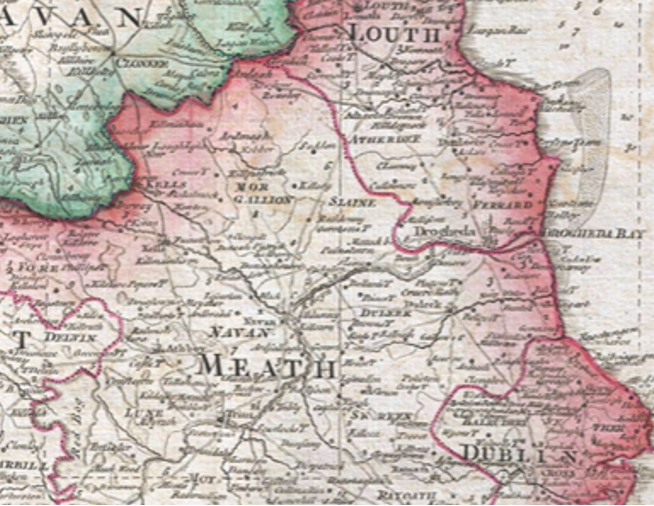
Figure 1. J Rocque, Map of Ireland, 1794, Source: Geographicus, Wikimedia Commons, https://commons.wikimedia.org/wiki/File:1794_Rocque_Wall_Map_of_Ireland_-_Geographicus_-_Ireland2-rocque-1794.jpg, edited by the author.
There are several inconsistencies throughout Michael’s records, but Mary Reilly (1817-1876), Michael Fullam’s future daughter-in-law, is the link who ties all the correct information together because Mary Morgan, Michael Fullam’s mother, is listed as a sponsor on Mary Reilly’s baptism record.[4]
Michael Fullam married a woman called Mary sometime before 1816-17, but their marriage record is not available and unfortunately her maiden name was not recorded on their children’s records when they were baptised at St Mary’s Pro-Cathedral, Marlborough St, Dublin City, Ireland (a Catholic cathedral formerly St Mary’s Chapel).[5] In 1817 and 1819, during the 1817-1819 Irish Typhus Epidemic, the couple’s first two children, also named Michael and Mary, were baptised while the family were at 5 Tuckers Row, Dublin, Ireland.[6] Two more children, Eliza and John, followed in 1820 and 1822, while at Cumberland Lane and Taffs Row respectively.[7]
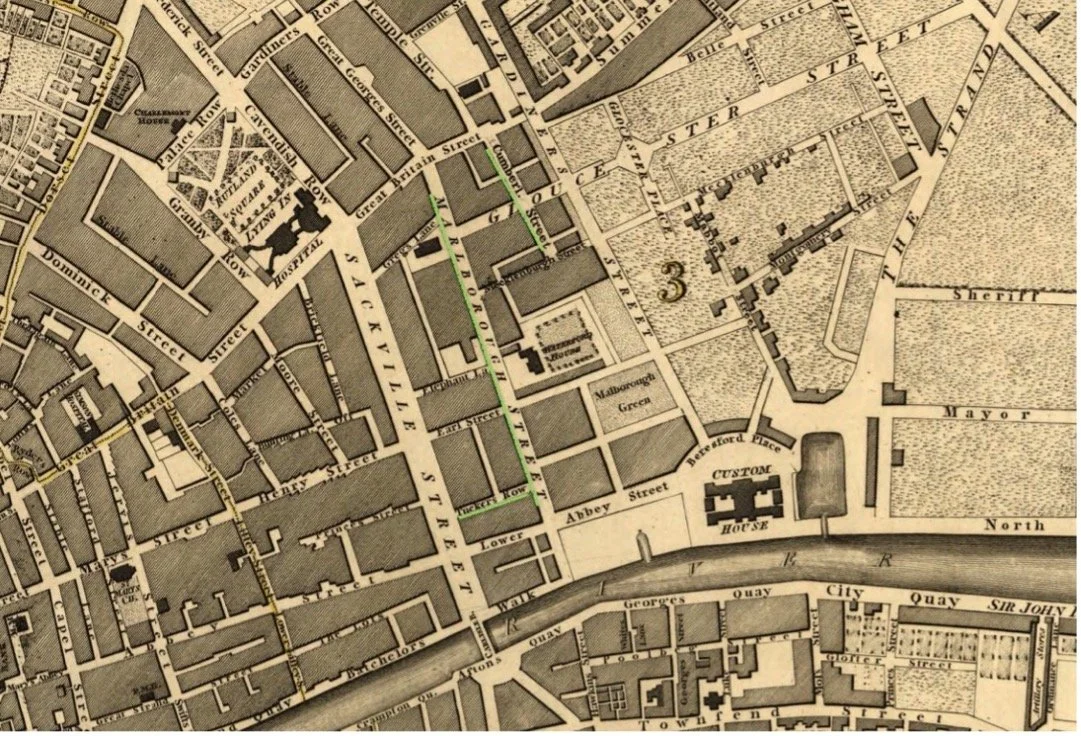
Figure 2. Faden, William, Samuel John Neele, J Archer, and W Allen, Plan of the City of Dublin, 1797, Library of Congress Geography and Map Division Washington, D.C , 2004626017, edited by the author, underlining Tuckers Row, Cumberland Street and Marleborough Street.
On 12 July 1824, Michael Fullam was tried for stealing horses in Dublin.[8] On the same day, Patrick Reilly, alias Caffery (the uncle of Michael Fullam’s future daughter-in-law Mary Reilly) was tried for stealing a mare in Dublin.[9] Both men are listed on the same 1824 Warrants of the Lord Lieutenant of Ireland.[10] Michael Fullam was sentenced to transportation for life and departed Ireland on 29 of October 1824, onboard the convict ship Asia from the Cove of Cork, Ireland, bound for New South Wales, along with Patrick Reilly and 187 other male convicts.[11] During the voyage, the convicts aboard the Asia were encouraged by the ship’s surgeon, James Alexander Mercer to be active and find amusements, such as dancing until 8 o’clock in the evening.[12] Most meals were eaten on deck and the convicts were given lemonade sweetened with sugar after every dinner at midday.[13] However, despite the fact that the ship experiences of Michael Fullam and his fellow convicts were better than many other convict ships, the trauma of being separated from the families, communities and country and forcibly transported to another country to work as unfree labour with little hope of return must be acknowledged.
The voyage lasted for 116 days, and the Asia landed at Port Jackson, Sydney on 21 February 1825.[14] Four days later, a muster was held on board by Colonial Secretary Frederick Goulburn.[15] Michael Fullam is described on the ship’s muster roll as a “Very Well” 5.6 ½ high, 30-year-old Catholic ploughman and shearer with brown hair, blue eyes and a fair, slightly pitted complexion.[16] It is not listed whether he could read and/or write.[17] All the convicts were landed 28 February 1825, and Michael Fullam was then assigned to work for John Palmer Esq (1760-1833).[18] Patrick Reilly (alias Caffery), was assigned to one of John Palmer’s sons, Lieut. John Palmer.[19]
In the 1828 New South Wales census, Michael Fullam is listed as a labourer for John Palmer Esq in Parramatta.[20] John Palmer, a First Fleeter who once held the position of Commissary-General of Australia, was a prominent landholder and businessman.[21] Together with his son George Thomas Palmer and Robert Campbell (who married John Palmer’s sister, Sophia), the three gentlemen established land holdings on the Limestone Plains, NSW, during the 1820s [22] Michael Fullam was moved to John Palmer’s newly acquired property, Jerrabomberra, which adjoined Robert Campbell’s property, Duntroon (later inherited by his son Charles Campbell).[23] George Thomas Palmer’s property, Ginninderra, was situated on the north border of Duntroon.[24] Over the years, Michael Fullam worked for the three land owners.[25] Although these men are depicted as being fair and kind, their significant role in the settler-colonisation of the region and dispossession of Indigenous peoples must be acknowledged.
In 1833, Michael Fullam was granted a ticket of leave with the condition he remain in the Argyle district of New South Wales.[26] That same year, John Palmer died.[27] George Thomas Palmer inherited Jerrabomberra, but was occupied running his property Ginninderra, so Jerrabomberra management was then taken over by his son Pemberton Campbell Palmer.[28] Consequently, Pemberton Palmer became Michael Fullam’s new employer, and was well known for being a colourful character who held horse races on his property, illegally sold alcohol and went before the magistrate more than once.[29]
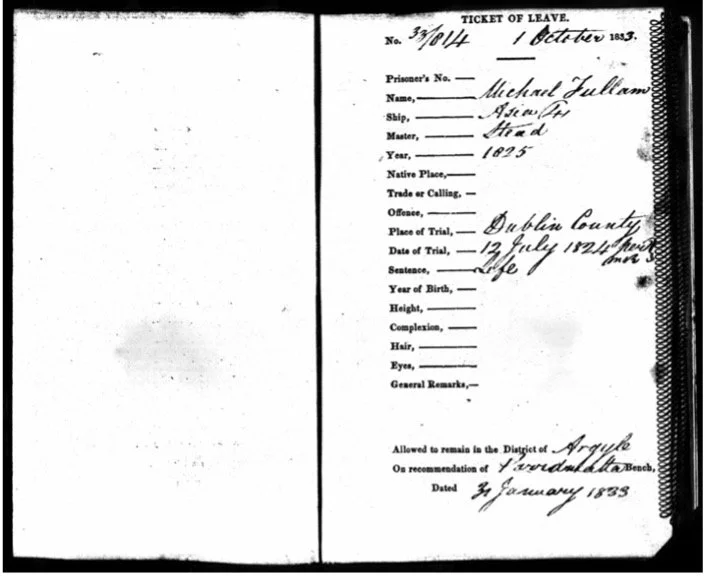
Figure 3, Michael Fullam, Ticket of Leave, 1833. Source: State Records NSW, ‘New South Wales, Australia, Tickets of Leave, 1810-1869’, Ancestry.com, accessed 5 March 2020.
Michael Fullam disappears from written records for several years before appearing in an 1837 muster under the name of “Fullen”, which was likely a misspelling or mishearing of his name by the clerk. Michael is listed as a ticket of leave holder in Maneroo (Monaro), where Robert and Charles Campbell had pasturage licenses, and where George Thomas Palmer had a camp near the future Coolamine homestead and an outpost at Eucumbene, below Kiandra on the Snowy River, so it is likely that he was still working for these men.[30] Furthermore, between 1828-1848 Michael Fullam [Fulham] appears three times on the 1828-1857 Queanbeyan Applications, which may have been connected to his work for the Palmers and Campbells as a bullock driver because, as a convict, he would have had to apply to the authorities leave his assigned area to be able to drive the bullocks to the required location.[31]
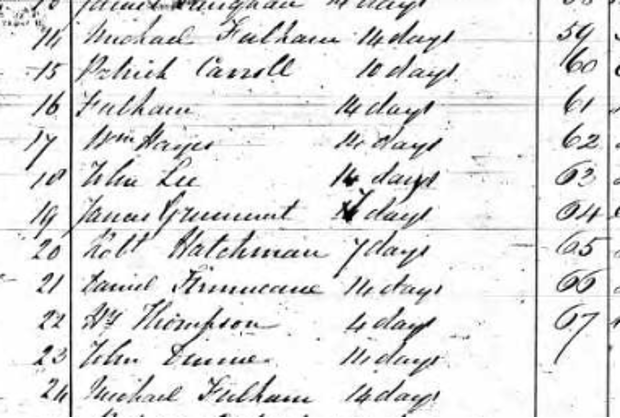
Figure 4. Queanbeyan Applications 1828-1857, New South Wales State Archives and Records, ‘New South Wales, Australia, Convict Records, 1810-1891’, Ancestry.com, edited by the author.
No records have been found suggesting Michael Fullam’s wife and children joined him in Australia and nor did he apply to remarry. However, three of Michael’s grandchildren, John, Thomas, and Mary immigrated to the same region as Michael after the Irish Potato Famine, which could suggest that Michael had been able to have some form of communication with his family. Sadly, it was too late for them to meet their grandfather.
On 12th February 1848, Michael Fullam was carrying a load for Mr Charles Campbell of Duntroon, Queanbeyan, when he was robbed and assaulted on the Paramatta Road while driving his bullock team, travelling closely between his neighbours Peter and William Drummond’s bullock teams.[33]
“James Carline was indicted for assaulting Michael Fulham on the Paramatta Road on the 12th February and casting him on the ground in the front of a dray and then with his hands and feet and the wheels of the dray inflicting wounds on the said Michael Fulham whereof he languished till the 19th March, and then died; William Pevey was also indicted for aiding and abet-ting; and both were indicted for the murdering of the said Michael Fulham.”
- ‘Late Robbery With Violence on the Parramatta Road’, Maitland Mercury and Hunter River General Advertiser, 24 March 1848, p.3.
Michael Fullam died from his injuries on 19 March 1848 shortly after 7.pm at the Sydney Benevolent Asylum and was buried 27 March in the Parish of St James, County of Cumberland.[34] No gravestone has been located.
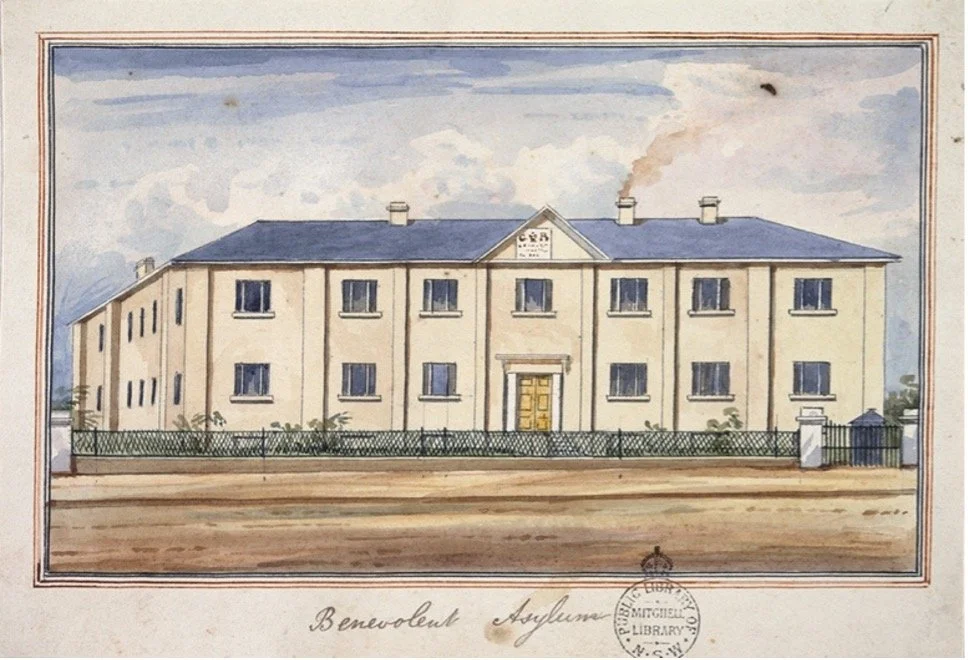
Figure 5. Benevolent Asylum, c1840-50, artist unknown, original held by Mitchell Library, State Library of New South Wales, call no. PX*D 123.
Michael’s story is a compelling example of the impacts of the convict system on both individuals and their families. During the early 19th century, widespread poverty and oppression drove many people to commit crimes. The convict system was designed to create unfree labour to expand the settler-colonisation of Australia, and even for an arguably minor crime Michael was given a life sentence as a convict.
______________________
I look forward to undertaking more research on Michael and his family in the future. When I do, I will be sure to share it here.
Best wishes,
Liliana
________________________________________________
References:
[1] Baptism for Michael Fullam baptised 7 December 1794, St Peter’s Church Parish Register, Drogheda, Co. Louth, Ireland, unpaginated, unnumbered, digitised Microfilm 05597/ 06, ‘Ireland, Catholic Patrick Registers, 1655-1915’, Ancestry.com.
[2] Baptism for Mariam Fullam, 13 March 1786, St Peter’s Church, Drogheda, Louth, Ireland, unpaginated, unnumbered, digitised Microfilm 05597/ 06, ‘Ireland, Catholic Patrick Registers, 1655-1915’ Ancestry.com.
[3] Michael Fullam, Asia, 1825, New South Wales State Archives and Records, NRS 12188, p.151 ‘New South Wales, Australia, Convict Indents, 1788-1842’, Ancestry.com.
4 Baptism of Mary Reilly, 12 March 1817, Swords Parish Register, Dublin, Ireland, unpaginated, unnumbered, digitised Microfilm 06616/ 06, ‘Ireland Catholic Parish Registers 1655-1915’ Ancestry.com.
[5] Baptism of Michael Fullam, baptised 7 July 1817, St Mary’s Pro-Cathedral Parish Register, Dublin city, Dublin, Ireland, p.16, 7 July-no.2, microfilm 09149 / 03, ‘Ireland, Catholic Parish Registers, 1655-1915’, Ancestry.com; Baptism of Mary Fullam, baptised 30 March 1819, St Mary’s Pro-Cathedral Parish Register, Dublin City, Dublin, Ireland, p.103, 30 March-no.4, microfilm 09149/03, ‘Ireland, Catholic Parish Registers, 1655-1915’, Ancestry.com; Baptism of Eliza Fullam, baptised 30 Oct 1820, St Mary’s Pro-Cathedral Parish Register, Dublin, Ireland, unpaginated, 30 Oct-No.7, microfilm 09150 / 01, ‘Ireland, Catholic Parish Registers, 1655-1915’, Ancestry.com; Baptism of John Fullam, baptised 11 Nov 1822, St Mary’s Pro-Cathedral Register, Dublin, Ireland, p.36, 11 Nov-No.4, microfilm 09150 / 02, ‘Ireland, Catholic Parish Registers, 1655-1915’, Ancestry.com; Visit Dublin, ‘St. Mary’s Pro Cathedral’, https://www.visitdublin.com/see-do/details/st-mary-s-pro-cathedral.
[6] Baptism of Michael Fullam [1817]; Baptism of Mary Fullam [1819]; Hugh Fenning, ‘Typhus Epidemic in Ireland, 1817-1819: Priests, Ministers, Doctors’, Collectanea Hibernica No.41, 1999, p.117-152.
[7] Baptism of Eliza Fullam; Baptism of John Fullam.
[8] Michael Fullam Asia, [1825], Ticket of Leave,1833, New South Wales State Archives and Records, NRS 12202, ‘New South Wales, Australia, Tickets of Leave, 1810-1869’, Ancestry.com; Michael Fullam, Convict Indent.
[9] Baptism of Patrick Reilly, baptised 20 September 1803, Kilskyre Parish Register, Co. Meath, Ireland, unpaginated, unnumbered, digitised microfilm 04186/04, Findmypast.com.au; Baptism of James Reilly, baptised 27 December 1799, Kilskyre Parish Register, County Meath, Ireland, unpaginated, unnumbered, digitised microfilm 04186/04, Findmypast.com.au; Patrick Caffery or Reilly, Asia, [1825], Ticket of Leave, 1840, New South Wales State Archives and Records, NRS 12204, ‘New South Wales, Australia, Tickets of Leave, 1810-1869’, Ancestry.com; Patrick Caffery or Reilly, Asia, [1825], Ticket of Leave, 1842, New South Wales State Archives and Records, NRS 12204, ‘New South Wales, Australia, Tickets of Leave, 1810-1869’, Ancestry.com.
[10] Warrants of the Lord Lieutenant of Ireland, 1824, Asia, New South Wales State Archives and Records, NRS 1156, Item [X30], p.3, ‘New South Wales, Australia, Convict Indents, 1788-1842’, Ancestry.com.
[11] Michael Fullam, Ticket of Leave, 1833; Michael Fullam, Warrants of the Lord Lieutenant of Ireland; Michael Fullam, Convict Indent; Census record for Michl [Michael] Fullum [Fullam], aged 40 [34], Parramatta, 1828 New South Wales Census, New South Wales State Archives and Records, NRS 1273, ‘1828 New South Wales, Australia Census (Australian Copy)’, Ancestry.com.
[12] Journal of the Asia, 1824-1825, Surgeon James Alexander Mercer, The National Archives, Kew, Surrey, England, ADM 101/53/3 ‘UK, Royal Navy Medical Journals, 1817-1857’, Ancestry.com.
[13] Journal of the Asia, 1824-1825, Surgeon James Alexander Mercer.
[14] Journal of the Asia, 1824-1825, Surgeon James Alexander Mercer.
[15] Journal of the Asia, 1824-1825, Surgeon James Alexander Mercer.
[16] Michael Fullam, Convict Indent.
[17] Michael Fullam, Convict Indent.
[18] Michael Fullam, Convict Indent; Michael Fullam, Asia, List of convicts landed from the Asia and forwarded to Parramatta for distribution, ‘New South Wales, Australia, Colonial Secretary’s Papers, 1788-1856’, Ancestry.com; Census record for Michael Fullam, Parramatta, 1828 New South Wales Census.
[19] Patrick Caffery or Reilly, List of convicts landed from the Asia and forwarded to Parramatta for distribution, ‘New South Wales, Australia, Colonial Secretary’s Papers, 1788-1856’, Ancestry.com; Free Settler or Felon [Jen Willetts] ‘Lieutenant John Palmer’, https://www.jenwilletts.com/john_palmer.htm.
[20] Census record for Michael Fullam, Parramatta, 1828 New South Wales Census; Household Returns, John Palmer, Parramatta, 1828 Census: Householders Returns, New South Wales State Archives and Records, NRS 1273, ‘1828 New South Wales, Australia Census (Australia Copy)’, Ancestry.com. .
[21] Margaret Steven, ‘Palmer, John (1760-1833)’, Australian Dictionary of Biography, National Centre of Biography, Australian National University, http://adb.anu.edu.au/biography/palmer-john-2533, published first in hardcopy 1967; First Fleet Fellowship Victoria Inc, ‘John Palmer’, https://firstfleetfellowship.org.au/stories/john-palmer/; Dictionary of Sydney, ‘Palmer, John’, https://dictionaryofsydney.org/person/palmer_john; Queanbeyan Museum, ‘Jerrabomberra’, https://queanbeyanmuseum.org.au/jerrabomberra/; State Records New South Wales, Colonial Secretary Index, 1788-1825, ‘Palmer, B to Palmer, James (1823)’, http://colsec.records.nsw.gov.au/p/F43c_pa-02.htm.
[22] Margaret Steven, ‘Palmer, John (1760-1833)’, Australian Dictionary of National Biography; First Fleet Fellowship Victoria Inc, ‘John Palmer’; Dictionary of Sydney, ‘Palmer, John’; Queanbeyan Museum, ‘Jerrabomberra’; State Records New South Wales, Colonial Secretary Index 1788 -1825, ‘Palmer, B to Palmer, James (1823)’; Margaret Steven, ‘Palmer, George Thomas (1784-1854)’, Australian Dictionary of Biography, National Centre of Biography, Australian National University, http://adb.anu.edu.au/biography/palmer-george-thomas-2532, published first in hardcopy 1967; Hall School Museum and Heritage Centre ‘Rediscovering Ginninderra: Palmerville Estate’, https://museum.hall.act.au/display/1939/place/1953/palmerville-estate.html; Eric Martin and Associates ‘West Belconnen European Cultural Heritage Report’, 2018, p.7 https://ginninderry.com/wp-content/uploads/2016/08/EMA.-2014b-European-heritage-NSW-land.pdf, p.7; Canberra Tracks, ‘Track 2: The Limestone Plains’, https://www.canberratracks.act.gov.au/heritage-trails/track-2-the-limestone-plains; Free Settler or Felon [Jen Willetts], ‘George Thomas Palmer and William Carter’, https://www.jenwilletts.com/george_thomas_palmer.htm; Hall School Museum and Heritage Centre ‘Rediscovering Ginninderra: Lieutenant George Thomas Palmer (senior)’ https://museum.hall.act.au/display/1939/person/2154/george-thomas-palmer-senior.html; Samuel Shumack, An Autobiography, or, Tales and Legends of Canberra Pioneers ANU Press, 1977, https://openresearch-repository.anu.edu.au/bitstream/1885/114750/2/b13217306.pdf; Margaret Steven, ‘Campbell, Robert (1769-1846)’, Australian Dictionary of National Biography, Australian National University, http://adb.anu.edu.au/biography/campbell-robert-1876/text2197, published first in hardcopy 1966; National Trust, ‘The Five Squires of Gungahlin’, https://www.nationaltrust.org.au/wp-content/uploads/2017/04/The-5-Squires-leaflet.pdf; Austar Coal Mine, ‘Historical Context’, http://www.austarcoalmine.com.au/icms_docs/276440_appendix-7---historical-context-of-the-lwb1-b3-modification-area.pdf.
[23] Michael Fulham [Fullam], Queanbeyan Applications 1828-1857, New South Wales State Archives and Records, Vol. 4/5651, 1848-p.1, ‘New South Wales, Australia, Convict Records, 1810-1891’, Ancestry.com; C. E. T. Newman, 'Campbell, Charles (1810–1888)', Australian Dictionary of Biography, National Centre of Biography, Australian National University, http://adb.anu.edu.au/biography/campbell-charles-1871/text2187, published first in hardcopy 1966; Hall School Museum and Heritage Centre ‘Rediscovering Ginninderra: Charles Campbell’ https://museum.hall.act.au/display/1939/person/1946/charles-campbell.html.
[24] Eric Martin and Associates ‘West Belconnen European Cultural Heritage Report’, p.7.
[25] Margaret Steven, ‘Palmer, John (1760-1833)’, Australian Dictionary of Biography; Margaret Steven, ‘Palmer, George Thomas (1784-1854)’, Australian Dictionary of Biography; Margaret Steven, ‘Campbell, Robert (1769-1846)’, Australian Dictionary of National Biography; C. E. T. Newman, 'Campbell, Charles (1810–1888)', Australian Dictionary of Biography.
[26] Michael Fullam, Asia, [1825] Ticket of Leave, 1833.
[27] Margaret Steven, ‘Palmer, John (1760-1833)’ Australian Dictionary of National Biography.
[28] Queanbeyan Museum, ‘Jerrabomberra’, Hall School Museum and Heritage Centre ‘Rediscovering Ginninderra: Lieutenant George Thomas Palmer (senior)’.
[29] Queanbeyan Museum, ‘Jerrabomberra’; Michael Fulham [Fullam], Queanbeyan Applications 1828-1857.
[30] Michael Fullen [Fullam], Maneroo, 1837 New South Wales Convict Muster, National Archives of the UK (TNA), Kew, Surrey, England, HO 10, Piece 33, ‘New South Wales and Tasmania, Australia Convict Musters, 1806, 1849’, Ancestry.com; New South Wales Archaeology, Dr Julie Dibden and Dr Rebecca Parks, ‘Heritage Assessment and Statement of Heritage Impact’, https://majorprojects.planningportal.nsw.gov.au/prweb/PRRestService/mp/01/getContent?AttachRef=SSI-9687%2120190925T085209.751%20GMT, p.62; ‘Pasturage Licenses’, New South Wales Government Gazette (Sydney, NSW: 1832- 1900) 19 Feb 1840, p.71.
[31] Michael Fulham [Fullam], Queanbeyan Applications 1828-1857; ‘Late Case of Assault And High Way Robbery’ Sydney Chronicle 23 March 1848, p.3; ‘Before His Honour Mr. Justice Manning. Murder.’ Sydney Morning Herald, 8 June 1848, p.3 ; ‘Central Criminal Court’ Maitland Mercury and Hunter River General Advertiser, 10 June 1848 ; ‘Inquest and Committal for Man-Slaughter’ Australian (Sydney, NSW : 1824 - 1848), 24 March 1848, p.3 ; ‘Central Criminal Court’ Australian (Sydney, NSW : 1824 - 1848) 9 Jun 1848, p.3; ‘Accidents, Offences & c’ Australian (Sydney, NSW : 1824 - 1848), 25 Feb 1848 p.3; ‘Late Robbery With Violence on the Parramatta Road’ Maitland Mercury and Hunter River General Advertiser 25 March 1848, p.4; ‘Highway Robbery’, Australian (Sydney, NSW : 1824 - 1848), 18 Feb 1848, p.3; ‘Inquests’ Sydney Chronicle 21 March 1848, p.2; ‘Late Robbery With Violence On The Parramatta Road’ Sydney Morning Herald, 21 March 1848, p.2; ‘The Highway Robbery And Assault In Parramatta-Street’, Sydney Morning Herald , 21 February 1848, p.2.
[33] ‘The Late Case of Assault And High Way Robbery’; ‘Before His Honour Mr. Justice Manning. Murder.’; ‘Central Criminal Court’ [10 June 1848]; ‘Inquest and Committal For Man-Slaughter’; ‘Central Criminal Court’ [9 June 1848]; ‘Accidents, Offences & c’ [25 February 1848]; ‘Late Robbery With Violence on the Parramatta Road’; ‘Highway Robbery’; ‘Inquests’; ‘Late Robbery With Violence on the Parramatta Road’, ‘The Highway Robbery And Assault In Parramatta-Street’.
[34] ‘The Late Case of Assault And High Way Robbery’; ‘Before His Honour Mr. Justice Manning. Murder.’; ‘Central Criminal Court’ [10 June 1848]; ‘Inquest and Committal For Man-Slaughter’; ‘Central Criminal Court’ [9 June 1848]; ‘Accidents, Offences & c’ [25 February 1848]; ‘Late Robbery With Violence on the Parramatta Road’; ‘Highway Robbery’; ‘Inquests’; ‘Late Robbery With Violence on the Parramatta Road’, ‘The Highway Robbery And Assault In Parramatta-Street’; Michael Fullam [Fulham], 20 March 1848, Register of Coroners Inquests, Sydney, New South Wales, unpaginated, no.4186, New South Wales State Archives and Records, NRS 343, ‘New South Wales, Australia, Registers of Coroners’ Inquests, 1821-1937’, Ancestry.com; Burial of Michael Fullam [Fulham], buried 27 March 1848, Burial Register, Parish of St James, Cumberland, New South Wales, Australia, unpaginated, New South Wales Registry of Births, Deaths and Marriages, Registration No. 1766, Vol. 116.