
Gender and the Women’s Weekly Cookbooks in 1970s and 1980s Australia
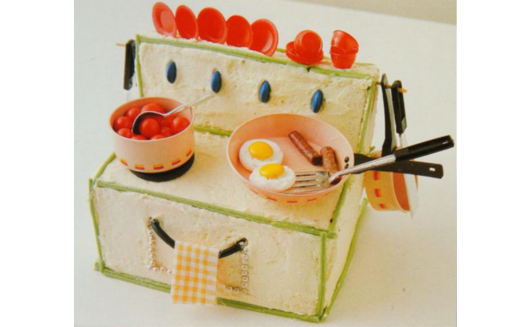
The “Stove” cake from the Australian Women’s Weekly Children’s Birthday Cake Book. (Pamela Clark, The Australian Women’s Weekly Children’s Birthday Cake Book (Sydney, 1990 [reprint of 1980 original edition]), p. 95).
To start off Women’s History Month this March, I am sharing my research into what the Australian Women’s Weekly cookbooks reveal about gender in 1970s and 1980s Australia.
The Australian Women’s Weekly (AWW) magazine was first published in 1933, and “within two decades, it had the largest circulation per capita of any women’s magazine in the world.”[1] The AWW cookbooks have become a ubiquitous and beloved part of Australian food culture, and the 1970s and 1980s saw the publication of approximately forty-five AWW cookbooks, including the Children’s Birthday Cake Book.[2] In this blog post, I examine two AWW cookbooks and one AWW recipe compilation published between 1970-1989 and argue that these cookbooks tell us that despite the changing ideas about gender and gender roles in 1970s and 1980s Australia, many traditional gender roles for women remained, particularly in the feminised space of the kitchen and the domestic tasks of cooking and baking.
Throughout early and mid-20th century Australia, gender roles for women were centred on domesticity, with marriage and motherhood being considered the ultimate goal, “though they [women] could work outside the home until marriage”.[3] These gender roles extended into the kitchen, where “restaurant food – ‘high class cookery’ – was the realm of men, while domestic food was the women’s realm.”[4] Domestic food, particularly meat, was also strongly linked to Australia’s “culture of respectability” and therefore the food that women cooked contributed to how their family was perceived.[5] However, the second-wave feminism of the 1970s, and 1980s dramatically changed the landscape of gender in Australia, and advances such as the wider availability of contraception, no-fault divorce in 1975, equal opportunity laws such as The Affirmative Action Act of 1986, and the growing recognition that “the personal is political” enabled women to reimagine their roles in the domestic sphere and in Australian society.[6]
The Australian Women’s Weekly (and its cookbooks) were primarily aimed at and read by working class and middle class white women, although a significant number of men read it too.[7] The magazine “prided itself on the way it treated women’s interests and newsworthy” and consistently promoted traditional gender roles for women while also having “relative willingness to engage with modern, feminist issues that mattered to Australian women”, particularly between 1977-1980.[8] This increased engagement with second-wave feminism was heavily influenced by the establishment of the Royal Commission on Human Relationships in 1974 and the appointment of Ita Buttrose as the AWW’s editor in 1975.[9] Ita Buttrose led the AWW’s groundbreaking Voice of the Australian Woman project in 1980, which is the “largest private study in Australian history” and made a significant impact on the lives of Australian women by giving them the opportunity to talk about (often taboo) topics that affected them.[10] As Ita Buttrose discusses, during this period “[w]omen were coming into their own. They realised, in these changing times with women's liberation, a stirring. Women were saying, "I don't want to put up with this anymore"”.[11] But nonetheless, many Australian women in 1970s and 1980s Australia retained their roles in the kitchen despite their greater autonomy, which the AWW cookbooks reflect.
The AWW’s 1978 cookbook Cooking for all Occasions (first published as The Australian Women’s Weekly New Cookbook that same year) provides an introduction to the gender roles around cookery in 1970s Australia.[12] As the title observes, the cookbook contains recipes for all occasions, including everyday meals, desserts, menus for dinner parties, and recipes for special occasions such as Christmas.[13] On the inside of the cookbook’s dust jacket, the cookbook implicitly associates cookery and domestic prowess with femininity by using gendered labels such as “the housewife” and “hostess”, and discusses how “[w]ith the help of Cooking For All Occasions you will always be prepared to cater for any number and any occasion and will enjoy serving your friends and family with dishes to be proud of.”[14]
This indicates that in 1970s Australia, the kitchen was still viewed as a feminine space in which it was considered the duty of women to provide meals for their families and demonstrate their domestic prowess through hosting.[15] The conflation of cooking and family life is also frequently repeated throughout the cookbook.[16] For example, the introduction to the “Hot Desserts” section remarks that “[t]hese are desserts the family will hurry home to in the cold winter weather”, which implies that the feminised space of the kitchen (and therefore the women cooking in it) were viewed as having a responsibility to encourage the family to return to the respectability of the home by cooking delicious food.[17]
The AWW also shared recipes and cookbooks aimed at the “liberated woman,” such as The Busy Woman’s Cookbook (published in 1972).[18] Although this cookbook is not currently available to view online, the AWW shared a compilation of 21 recipes titled “The Busy Woman’s Cookbook” in a 1980 issue of the magazine.[19] The majority of these recipes are listed as taking under 50 minutes to make, and most served between 2-4 people, which reflects the fact that women were cooking for smaller families in the 1980s.[20] The introduction to this recipe compilation states that “When each minute counts, you want recipes that let you put a hot meal on the table in a hurry”.[21] This statement suggests that although women were “busier”, they were still expected to provide a hot, home-cooked meal for their families.[22] Consequently, this indicates that in 1970s and 1980s Australia, cookery was considered a gender role that women should never neglect despite the other demands on their time.[23]
The title “Busy Woman” refers to the immense changes that were occurring around women’s roles in the home and workplace in 1970s and 1980s Australia, which resulted in many women managing both a job and caring for their family.[24] For example, one AWW article published in 1978 examines the pressure that many working mothers felt to be a “full-time wife and mother”, and their own “need [for] the stimulation of an outside job.”[25] The author of the article remarks that she is “thankful that society's images of the perfect wife and mother are changing” and that “there's no reason to feel guilty if my cakes come from the shelf and not the oven” which further indicates that the traditional gender roles of 1970s and 1980s Australia were centred on the feminised space of the kitchen.[26] Nevertheless, as the above quote reflects, home baking was declining during this period, and “Australians were more likely to purchase their baked goods from a supermarket.”[27]
Despite this decline in home baking, the AWW began publishing recipes for children’s birthday cakes throughout the 1970s, and in 1980 published the ‘“phenomenal cultural icon” that is The Australian Women’s Weekly Children’s Birthday Cake Book.[28] Although most of the Children’s Birthday Cake Book cakes are not explicitly aimed at a specific gender, it is still a highly gendered cookbook.[29] Toward the end of the cookbook are two gendered sections labelled “For Boys” and “For Girls”, which explicitly represent what activities were considered acceptable for males and females in Australian society.[30] For example, the “For Boys” section contains cakes based on activities undertaken in the external, public sphere, such as rockets, cars and trucks, and aeronautics, which reveals that in 1980s Australia, males were seen as “belonging,” even from childhood, in spheres that involved science, space travel, mechanics, and aeronautics.[31] In contrast, many of the cakes in the “For Girls” section are domestic, such as a sewing machine cake, a sewing basket, a stove, a dressing table, a tea party, and a “baby in basket”.[32] These cakes clearly indicate that in 1980s Australia, females were commonly seen as predestined to belong in the domestic sphere, where their primary role was to care for the home and become mothers.[33]
It must be recognised that the gendered nature of these cakes did draw criticism, and the cookbook’s author, Pamela Clark, recalled that “the Weekly Test Kitchen’s phones rang off the hook with people saying, ‘How dare you segregate boys and girls? How sexist of you’”.[34] Nonetheless, these gendered cakes demonstrate that gender roles were still ubiquitous in 1980s Australia, to the point that they even infiltrated children’s birthday cakes.
Another cake in the “For Girls” section is the “Sweet Shop”, which reveals that the traditional conflation of femininity with sugar and sweetness continued into late 20th century Australia.[35] As Toni Risson discusses, “Women and decorated cakes connote sweetness, frilliness and the trivial, and as objects of the gaze, or ‘eye candy’, neither has traditionally been viewed as important, essential or serious”.[36] Furthermore, most of the people baking the cakes were mothers, and the immense popularity of the cookbook led to mothers being pressured to make these cakes for their children.[37] Therefore, it could be argued that sugar and sweetness in 1980s Australia became associated not just with femininity, but with ideals of motherhood too.
The pressure placed upon mothers to make cakes from the Children’s Birthday Cake Book for their children was intense.[38] As Lauren Samuelsson and Julie Parsons discuss, the cookbook “served to reinforce ‘appropriate middle-class maternal foodways’ and encouraged competition and performance in the act of mothering”.[39] The AWW’s focus on birthday cakes during this period was also strongly linked to evolving nature of women’s roles in Australian society, and served as a way for working mothers to continue displaying their culinary prowess and prove that they were still “good mothers” by making these elaborate cakes for their children.[40]
Comparing the gender roles that are present in all three AWW cookbooks examined here offers compelling insights into the continually changing ideas around gender in 1970s and 1980s Australia, as the cookbooks appear to be arguing that a woman’s “business” was no excuse to not be an accomplished cook and skilled hostess who made elaborate birthday cakes for her children.[44] But, it must be noted that the recipes in the Busy Woman’s Cookbook compilation and the Children’s Birthday Cake Book (and to a much lesser extent the Cooking for All Occasions cookbook) frequently include pre-made (and therefore time saving) ingredients, such as cake mixes, pre-made lollies, packaged flan cases, packet macaroons, pre-made sweet toppings, stock cubes, and canned soup.[45] This indicates that it was becoming accepted – and even encouraged – for women to use such significant shortcuts in the kitchen in order to fulfil female gender roles.[46]
Through this lens, the time-saving ingredients in these cookbooks could suggest that the AWW was encouraging women to enter the workplace by showing them that it was indeed possible to still fulfil their roles in the home if they adopted quick recipes that included premade elements.[47] Conversely, the AWW could also be reminding women that regardless of their “busy” lifestyles or jobs, they still had a duty to perform in the kitchen.[48] Both points could be true, which connects back to the AWW’s frequently nonpartisan stance on gender roles.[49] However, I would argue that the fact that cookbooks like Cooking for All Occasions and The Busy Woman’s Cookbook recipe compilation were created at all confirms that there was indeed an audience of women who still wanted to fulfil the traditional gender roles in the kitchen despite their changing lifestyles. Likewise, the Children’s Birthday Cake Book’s enduring popularity indicates that cooking and baking remained a point of pride for mothers, and an expression of “female creativity””.[50]
In conclusion, The Australian Women’s Weekly cookbooks, such as the Cooking for All Occasions Cookbook, The Busy Woman’s Cookbook recipe compilation, and the Children’s Birthday Cake Book tell us that the second-wave feminist movement in 1970s and 1980s Australia was not a simple, linear process, but a complex social development during which many women were experiencing greater autonomy, but also continued to fulfil traditional gender roles. These gender roles were particularly focussed on the feminised space of the kitchen, where women were expected to (and did) hold culinary prowess and make impressive meals and cakes for their families, albeit with the frequent assistance of premade elements that helped them to balance their changing lifestyles.
______________________________
REFERENCES:
[1] Lauren Samuelsson, A Matter of Taste: The Australian Women’s Weekly and Its Influence on Australian Food Culture (Sydney 2024), p. 2.
[2] The number of cookbooks was derived from a trove.nla.gov.au search for keywords (entered in “all of these words”) “Australian Women’s Weekly Cookbook” Year range from: 1970. Year range to: 1989. In “Books and Libraries”. 87 results. Duplicate and irrelevant cookbooks in the search results were then eliminated and the approximate number of cookbooks was then counted. However, some AWW cookbooks published during this period may not be listed on Trove. Link to Trove search results: https://trove.nla.gov.au/search/advanced/category/books?keyword=Australian%20Women%27s%20Weekly%20Cookbook&date.from=1970&date.to=1989, accessed 29 April 2025; Samuelsson, A Matter of Taste, pp. 2-4, 6, 15, 16-18, 187-188.
[3] Katie Holmes and Sarah Pinto, ‘Gender and Sexuality.’ in Alison Bashford and Stuart Macintyre (eds), The Cambridge History of Australia (Cambridge 2013), pp. 308-331; Samuelsson, A Matter of Taste, pp. 25, 43-45.
[4] Samuelsson, A Matter of Taste, p. 23.
[5] Samuelsson, A Matter of Taste, pp. 41-45, 132-139. 144-147, 188.
[6] Holmes and Pinto, ‘Gender and Sexuality’ p. 324-331; Michelle Arrow, ‘The Seventies: The Personal, the Political and the Making of Modern Australia’, Agora, volume 55, issue 1 (2020), pp.18–23.
[7] Samuelsson, A Matter of Taste, pp. 22-25.
[8] Leah Nichol, ‘The Royal Commission on Human Relationships and the Australian Women’s Weekly, 1977–1980: The Personal, the Political, the Popular’, Australian Feminist Studies, Volume 37, number 111 (2022), pp. 83-84; Zara Saunders, ‘Equal Social Rights For SEXES’: in the 1930s, the Australian Women’s Weekly was a political forum’, The Conversation, 11 October 2023, https://theconversation.com/equal-social-rights-for-sexes-in-the-1930s-the-australian-womens-weekly-was-a-political-forum-212770.
[9] Nichol, ‘The Royal Commission on Human Relationships and the Australian Women’s Weekly, 1977–1980: The Personal, the Political, the Popular’, pp. 75-77, 81-84; Arrow, ‘‘The Seventies: The Personal, the Political and the Making of Modern Australia’, pp. 22-23; Juliet Rieden, ‘Ita Buttrose shares her favourite memories of The Australian Women’s Weekly’, The Australian Women’s Weekly, 16 November 2023, https://www.womensweekly.com.au/news/ita-buttrose-womens-weekly/.
[10] Juliet Rieden, ‘Ita Buttrose shares her favourite memories of The Australian Women’s Weekly’; Nichol, ‘The Royal Commission on Human Relationships and the Australian Women’s Weekly, 1977–1980: The Personal, the Political, the Popular’, pp. 75-77, 81-84.
[11] Juliet Rieden, ‘Ita Buttrose shares her favourite memories of The Australian Women’s Weekly’.
[12] Ellen Sinclair, Cooking for all Occasions ([place of publication not listed] 1978), p. 6 [copyright page].
[13] Sinclair, Cooking for all Occasions, p. 7.
[14] Sinclair, Cooking for all Occasions, inside dustjacket.
[15] Sinclair, Cooking for all Occasions, inside dustjacket; Samuelsson, A Matter of Taste, pp. 23-24, 134-143.
[16] Ellen Sinclair, Cooking for all Occasions, see for example pp. 25, 28, 36, 77, 101, 141, 161, 173, 188, 225, 227, 237.
[17] Sinclair, Cooking for all Occasions, p. 173; Samuelsson, A Matter of Taste, pp. 43-45.
[18] Samuelsson, A Matter of Taste, p. 25; ‘Advertising’, The Australian Women's Weekly, 12 December 1973, p. 52a, http://nla.gov.au/nla.news-article46451200.
[19] ‘The Busy Woman's Cookbook’, The Australian Women's Weekly, 2 April 1980, pp. 69-72, 75-76, 79, 83, http://nla.gov.au/nla.news-article55456662.
[20] ‘The Busy Woman's Cookbook’, pp. 69-72, 75-76, 79, 83; Holmes and Pinto, ‘Gender and Sexuality’, pp. 324, 328.
[21] ‘The Busy Woman's Cookbook’, The Australian Women's Weekly, p. 69.
[22] ‘The Busy Woman's Cookbook’, The Australian Women's Weekly, p. 69; Lauren Samuelsson, ‘Ita Buttrose, Dulcie Boling, and Nene King: The Construction of ‘Idealised Feminine Leadership’ in the Australian Media,
1972–1999’, Australian Feminist Studies 2023, Volume 38, number 117 (2023), pp. 325-327, 334-335.
[23] Samuelsson, A Matter of Taste, p. 25; Samuelsson, ‘Ita Buttrose, Dulcie Boling, and Nene King: The Construction of ‘Idealised Feminine Leadership’ in the Australian Media, 1972–1999’, pp. 325-327, 334-335.
[24] Maggie Osborne, ‘The day I stopped feeling guilty’ The Australian Women's Weekly, 17 May 1978, pp. 67, 71-72, http://nla.gov.au/nla.news-article47247157; Samuelsson, A Matter of Taste, p. 25; Samuelsson, ‘Ita Buttrose, Dulcie Boling, and Nene King: The Construction of ‘Idealised Feminine Leadership’ in the Australian Media, 1972–1999’, pp. 325-327, 334-335.
[25] Maggie Osborne, ‘The day I stopped feeling guilty’, The Australian Women's Weekly, p. 72.
[26] Ibid.
[27] Lauren Samuelsson, ‘The imitation game: Mock Foods in the Australian Women’s Weekly 1933-82’, University of Wollongong. https://hdl.handle.net/10779/uow.27732444.v1, pp. 22-23.
[28] Kelly Burke, ‘Remembering the Australian Women’s Weekly birthday cake book: ‘A phenomenal cultural icon’’, The Guardian, 30 May 2023, https://www.theguardian.com/artanddesign/2023/may/30/cakes-frocks-and-war-correspondents-90-years-of-australian-womens-weekly; Samuelsson, A Matter of Taste, p. 95.
[29] Pamela Clark, The Australian Women’s Weekly Children’s Birthday Cake Book (Sydney, 1990 [reprint of 1980 original edition]), for non-gendered examples, see sections “For Everyone” and “Numbers”; Samuelsson, A Matter of Taste, p. 98.
[30] Clark, The Australian Women’s Weekly Children’s Birthday Cake Book, pp. 78-107; Samuelsson, A Matter of Taste, p. 98.
[31] Clark, The Australian Women’s Weekly Children’s Birthday Cake Book, pp. 79-89; Samuelsson, A Matter of Taste p.98.
[32] Clark, The Australian Women’s Weekly Children’s Birthday Cake Book, pp. 91-107; Samuelsson, A Matter of Taste p.77, 98.
[33] Clark, The Australian Women’s Weekly Children’s Birthday Cake Book, pp. 79-89; Samuelsson, A Matter of Taste p.98.
[34] Pamela Clark quoted in Lauren Samuelsson, A Matter of Taste, p. 98; ‘How the Women's Weekly Children's Birthday Cake Book changed the shape of Australian birthdays’, ABC News, 9 September 2016, https://www.abc.net.au/news/2018-09-09/childrens-birthday-cake-book-changed-shape-kids-birthdays/10208246.
[35]Fabio Parasecoli, ‘Gender’, in Goldstein, Mintz, Krondl et al, The Oxford Companion to Sugar and Sweets (Oxford 2016), accessed online, https://www.oxfordreference.com/view/10.1093/acref/9780199313396.001.0001/acref-9780199313396-e-221; Amy Bently, ‘Sugar Rationing’, in Goldstein, Mintz, Krondl et al, The Oxford Companion to Sugar and Sweets, https://www.oxfordreference.com/view/10.1093/acref/9780199313396.001.0001/acref-9780199313396-e-520; Lauren Samuelsson, A Matter of Taste, pp. 76-77; Toni Risson, “Eating It Too: ‘The Icing on the (Birthday) Cake.’’ The Australasian Journal of Popular Culture, volume 2, no. 1 (2012), pp. 72-73.
[36] Risson, ‘Eating It Too: ‘The Icing on the (Birthday) Cake.’’, p. 73.
[37] Risson, ‘Eating It Too: ‘The Icing on the (Birthday) Cake.’’, p. 74; Samuelsson, A Matter of Taste, p. 97-99.
[38] Risson, ‘Eating It Too: ‘The Icing on the (Birthday) Cake.’’, p. 74; Samuelsson, A Matter of Taste, p. 97-99.
[39] Julie Parsons quoted in Samuelsson, A Matter of Taste p. 97.
[40] Lauren Samuelsson, A Matter of Taste, pp. 97-99; Risson, ‘Eating It Too: ‘The Icing on the (Birthday) Cake.’’, p. 74
[41] Lauren Samuelsson, A Matter of Taste, p. 99; Risson, ‘Eating It Too: ‘The Icing on the (Birthday) Cake.’’, p. 73.
[42] Clark, The Australian Women’s Weekly Children’s Birthday Cake Book, pp. 46, 124-125.
[43] ‘How the Women's Weekly Children's Birthday Cake Book changed the shape of Australian birthdays’, ABC News.
[44] Sinclair, Cooking for all Occasions; ‘The Busy Woman's Cookbook’, The Australian Women's Weekly; Clark, The Australian Women’s Weekly Children’s Birthday Cake Book; Samuelsson, A Matter of Taste, pp. 96-99, 136-139; Risson, ‘Eating It Too: ‘The Icing on the (Birthday) Cake.’’, p. 74.
[45] The Australian Women’s Weekly Children’s Birthday Cake Book, pp. 2-3; ‘The Busy Woman's Cookbook’, The Australian Women's Weekly, pp. 69-72, 75-76, 79, 83; for examples of recipes with premade elements in Cooking for All Occasions, see pages 90, 98, 101, 103-104, 111, 130, 132, 158-159, 166, 203, 240, 243.
[46] Samuelsson p. 94, 96-98; Risson, ‘Eating It Too: ‘The Icing on the (Birthday) Cake.’’, p. 69.
[47] Samuelsson, A Matter of Taste, p. 25.
[48] Samuelsson, ‘Ita Buttrose, Dulcie Boling, and Nene King: The Construction of ‘Idealised Feminine Leadership’ in the Australian Media, 1972–1999’, pp. 325-327; Samuelsson, A Matter of Taste, p. 25.
[49] Nichol, ‘The Royal Commission on Human Relationships and the Australian Women’s Weekly, 1977–1980: The Personal, the Political, the Popular’, pp. 83-84; Zara Saunders, ‘Equal Social Rights For SEXES’: in the 1930s, the Australian Women’s Weekly was a political forum’.
[50] Samuelsson, A Matter of Taste, p. 77, 97-98.
___________________
BIBLIOGRAPHY
PRIMARY SOURCES
‘Advertising’, The Australian Women's Weekly, 12 December 1973, p. 52a, http://nla.gov.au/nla.news-article46451200.
‘The Busy Woman's Cookbook’, The Australian Women's Weekly, 2 April 1980, pp. 69-72, 75-76, 79, 83, http://nla.gov.au/nla.news-article55456662.
Clark, Pamela, The Australian Women’s Weekly Children’s Birthday Cake Book (Sydney, 1990 [reprint of 1980 original edition]).
Osborne, Maggie, ‘The day I stopped feeling guilty’ The Australian Women's Weekly, 17 May 1978, pp. 67, 71-72, http://nla.gov.au/nla.news-article47247157.
Sinclair, Ellen, Cooking for all Occasions ([place of publication not listed] 1978).
SECONDARY SOURCES
Arrow, Michelle, ‘The Seventies: The Personal, the Political and the Making of Modern Australia’, Agora, volume 55, issue 1 (2020), pp. 18-23.
Bently, Amy, ‘Sugar Rationing’, in Goldstein, Mintz, Krondl et al, The Oxford Companion to Sugar and Sweets, https://www.oxfordreference.com/view/10.1093/acref/9780199313396.001.0001/acref-9780199313396-e-520.
Burke, Kelly, ‘Remembering the Australian Women’s Weekly birthday cake book: ‘A phenomenal cultural icon’’, The Guardian, 30 May 2023, https://www.theguardian.com/artanddesign/2023/may/30/cakes-frocks-and-war-correspondents-90-years-of-australian-womens-weekly.
Clark, Pamela, Leigh Tonkin, Dave May, and Richard Mockler, ‘How the Women's Weekly Children's Birthday Cake Book changed the shape of Australian birthdays’, ABC News, 9 September 2016, https://www.abc.net.au/news/2018-09-09/childrens-birthday-cake-book-changed-shape-kids-birthdays/10208246.
Holmes, Katie, and Sarah Pinto, ‘Gender and Sexuality.’ in Alison Bashford and Stuart Macintyre (eds), The Cambridge History of Australia (Cambridge 2013), pp. 308-331.
Nichol, Leah, ‘The Royal Commission on Human Relationships and the Australian Women’s Weekly, 1977–1980: The Personal, the Political, the Popular’, Australian Feminist Studies, Volume 37, number 111 (2022), pp. 71-85.
Parasecoli, Fabio, ‘Gender’, in Goldstein, Mintz, Krondl et al, The Oxford Companion to Sugar and Sweets (Oxford 2016), accessed online, https://www.oxfordreference.com/view/10.1093/acref/9780199313396.001.0001/acref-9780199313396-e-221.
Rieden, Juliet, ‘Ita Buttrose shares her favourite memories of The Australian Women’s Weekly’, The Australian Women’s Weekly, 16 November 2023, https://www.womensweekly.com.au/news/ita-buttrose-womens-weekly/.
Risson, Toni, “Eating It Too: ‘The Icing on the (Birthday) Cake.’’ The Australasian Journal of Popular Culture, Volume 2, no. 1 (2012), pp. 57-78.
Samuelsson, Lauren, ‘Ita Buttrose, Dulcie Boling, and Nene King: The Construction of ‘Idealised Feminine Leadership’ in the Australian Media, 1972–1999’, Australian Feminist Studies 2023, Volume 38, number 117 (2023), pp. 321-338.
Samuelsson, Lauren, ‘The imitation game: Mock Foods in the Australian Women’s Weekly 1933-82’, University of Wollongong. https://hdl.handle.net/10779/uow.27732444.v1, pp. 1-24.
Samuelsson, Lauren, A Matter of Taste: The Australian Women’s Weekly and Its Influence on Australian Food Culture (Sydney 2024).
Saunders, Zara, ‘Equal Social Rights For SEXES’: in the 1930s, the Australian Women’s Weekly was a political forum’, The Conversation, 11 October 2023, https://theconversation.com/equal-social-rights-for-sexes-in-the-1930s-the-australian-womens-weekly-was-a-political-forum-212770.