
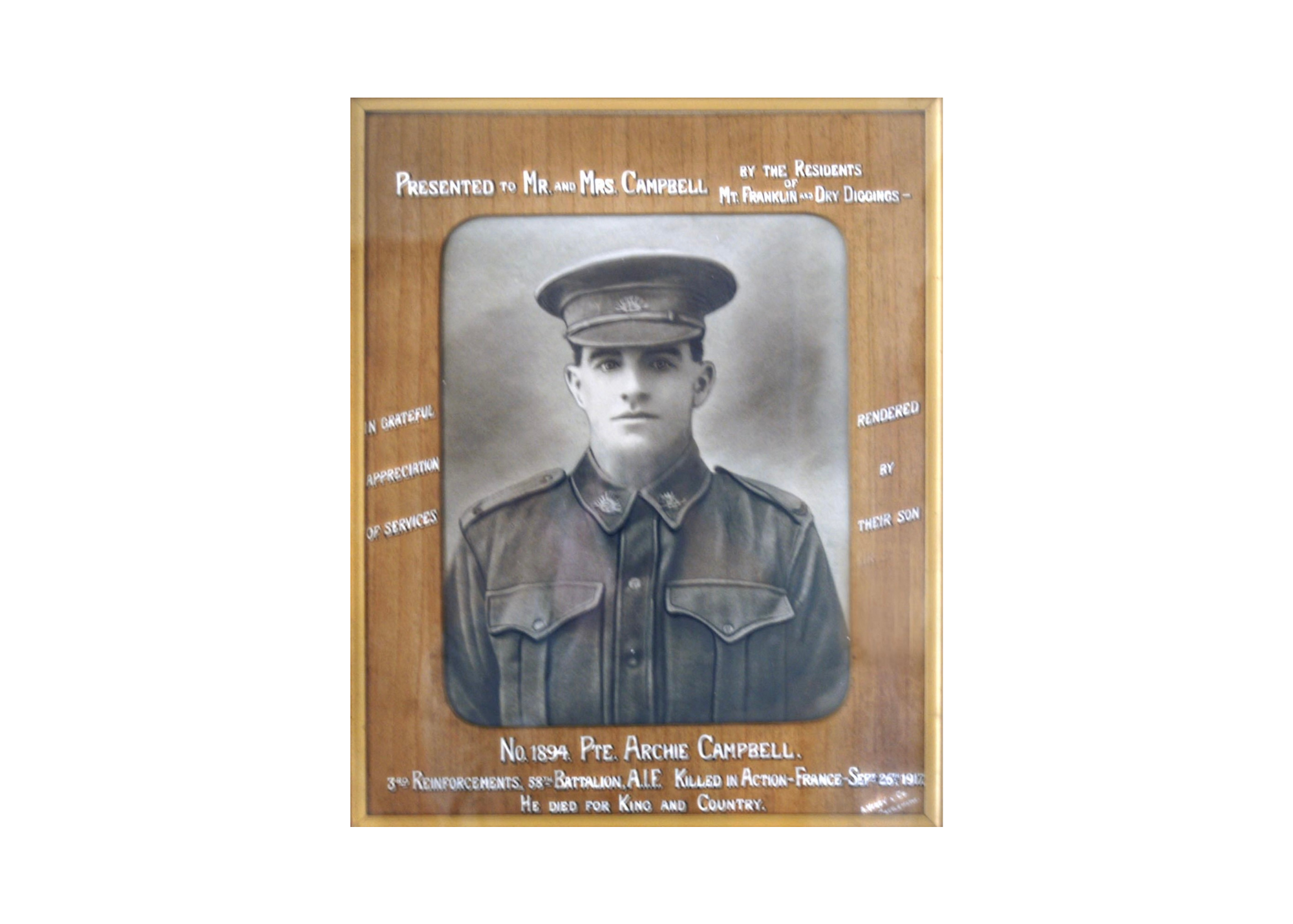
In honour of ANZAC Day in Australia, I am sharing the research I have undertaken on the wartime service of my great great-granduncle Archibald Campbell (Archie), who was killed in action during WWI. ANZAC Day is a day to remember, honour and commemorate the service people of Australia and New Zealand. The date, 25th of April, is the anniversary of Australian and New Zealand troops landing at Gallipoli in 1915. It is not a day for celebration, parties or tokenistic gestures, but of respect and remembrance for the sacrifices Australia and New Zealand’s service people have made, in all wars.
ANZAC Day is also not the only day in the year to commemorate service people. For example, whenever I see a war memorial, I like to pause and consider the people listed there, and quietly thank them for their service. If you would like to find a war memorial near you, Virtual War Memorial Australia has a very helpful map of war memorials from all over the world.
________________________
I have been researching Archie and his family for a long time, and it is clear that he was beloved by many and the impact his death had on his family and their descendants was profound. After he was killed in action 26 September 1917 at the Battle of Polygon Wood during the WWI Third Ypres Offensive on the Western Front, tributes and memoriam notices praising his gentle and brave nature appeared in the Australian newspapers until 1921, and even to this present day, Archie’s descendants continue to speak of his name with fond affection and pride.[1] This blog post will focus on Archie’s war service, with a brief introduction to his early life, then enlistment, overseas service, death at Polygon Wood and how he was commemorated posthumously by his family and community.
Archie was born 14 August 1890, at Wombat Siding, Mt Franklin region, Victoria, the thirteenth of John Campbell Colquhoun and Barbara Ellen Cowen’s fifteen children.[2] John Campbell Colquhoun informally changed his surname to Campbell (his middle name and his mother’s maiden name) shortly after marrying Barbara in 1865.[3] Archie grew up in the Mount Franklin region of Victoria, attended the Dry Diggings and Barkstead State School and by age nineteen was working as a miner alongside his father and three of his brothers.[4] In early 1916, Archie worked as a supernumerary porter for the Geelong railway station and lived at 18 Gertrude St, Geelong with his brother Robert, Robert’s wife Maggie and their four children.[5] Archie’s sweetheart and family friend from Daylesford, Ada Alverne Cock, was living in Parkville, Melbourne at the time.[6]
Archie enlisted in the 3rd Reinforcements, 58th Battalion, 5th Australian Division, I Anzac Corps, 2 February 1916 in Geelong.[7] He was described on his enlistment papers as 5 ft 7 ½”, with black hair, blue eyes, a darker complexion, Presbyterian religion.[8] He had no previous military service and named his mother Barbara as next of kin on his enlistment papers and will.[9] Archie’s reasons for enlisting may have been influenced by a number of factors, including his older brothers Alexander and John signing up in July 1915 and January 1916, the evacuation of the Anzac Peninsula, the beginning of the conscription debate, and shaming tactics used by pro-war advocators to make men enlist.[10]
Archie trained at the Geelong Camp and Broadmeadows, going on occasional leave.[11] His training included basic knowledge of drilling, listening to and understanding military commands and operating equipment such as machine guns, with a particular emphasis on rifles.[12] During this time, the staff at the Geelong railway station threw a party for Archie and gave him a signet ring and a silver pencil.[13] Archie and the 3rd Reinforcements left Australia 8 July 1916 onboard the HMS Ajana and called at four ports, Fremantle, Durban, Cape Town and St Vincent Island.[14] HMS Ajana landed at Plymouth, England in late August and on the 1st September 1916 the soldiers surveyed roughly one hundred miles to Salisbury Plain, where Archie was admitted to hospital as slightly sick.[15] In Salisbury, Archie was also able to meet up with his brother Alexander and describes his time there to his sister Annie in the only letter of his known to survive, dated 27 November 1916: [16]
“I had the good luck to find Alex there at Salisbury while we were there King reviewed some 50 thousand Australians, some mass of men when you see them all together.” [17]
On the 13th September 1916 Archie marched out to Perham Downs with the 15th Training Battalion.[18] The battalion then travelled to Codford and the soldiers were given four days leave in London.[19] From Codford, Archie then stayed in Hurcott for at least eight weeks until his battalion left for France.[20] His attitude to the war and fighting at this time appears relaxed but eager to get going and in the letter to Annie he writes:
“Our next ship will be to France I suspect we will be there long before this letter reaches you we have everything packed ready to go at a moment’s notice in fact I thought we would have been there long before now but will be going sometime this week I think”.[21]
Archie signs off saying he would have liked to see everyone before he left but hoped to be back soon.[22]
Archie and the 3rd Reinforcements sailed to France on the SS Princess Henrietta, 6 Dec 1916 and was taken on the strength of the 58th Battalion at Étaples, 21st December 1916.[23] Until August 1917 Archie’s further service is unrecorded, but by studying the 58th Battalion’s movements, it can be concluded that Archie likely saw action at the Second Battle of Bullecourt before the 5th Australian Division was withdrawn for a long period of rest then transferred to Ypres.[24] Until September 1917, the 58th Battalion enjoyed a rest period from the front lines in Hazebrouck, France, and were employed in rigorous training dispersed with more pleasant activities such as Archie’s company, the “B” Company, playing in a football match against the “A” Company.[25] While in Hazebrouck, Archie made a knife from a German cartridge and a shrapnel bullet and sent it to a Daylesford town clerk.[26] In his accompanying note, Archie stated that he had been lucky so far and “was determined to stick it to the last.”[27]
The 58th Battalion followed the 5th Australian Division into the Third Ypres Offensive, and played a significant role at the Battle of Polygon Wood.[28] Although the Allies won the battle, Polygon Wood resulted in approximately 5,744 Australian casualties.[29] Archie’s service record states he was killed in action 26th September 1917 at Polygon Wood (sometimes referred to as Glencorse Wood), and by analysing the 58th Battalion diary for the 25-27 September, Charles Bean’s Official Histories, information from the Passchendaele Archives website, and information from oral history interviews by a member of Archie’s battalion, it can be concluded that Archie was killed either by German shellfire at approximately 1am, 26 September 1917, or by another round of German shellfire and artillery while the 58th battalion was in reserve at Polygon Wood during an attack against the Germans led by the 31st, 29th and 59th Australian battalions; this could place the time of Archie’s death between 12pm – 10pm, 26 September 1917, possibly in the vicinity of the Butte of Polygon Wood.[30]
Archie was buried in the vicinity of Polygon Wood.[31] His body was never found or recovered after the war, and his grave was likely destroyed by the further action in the area.[32] Archie’s mother tried for several years to find Archie’s grave through the war office, but to no avail.[33] After the news of Archie’s death reached his family, numerous memoriams were inserted into the Daylesford and Melbourne newspapers.[34] The residents of Mt Franklin and Dry Diggings gifted a photograph of Archie in a beautiful wooden frame to his parents in appreciation for Archie’s service.[35] Ada and her parents both put their own heartfelt tributes to Archie in the Melbourne newspapers in 1918 and 1919.[36] .Archie is commemorated on the Menin Gate Memorial, panel 7-17-23-25-27-29-31, panel 65 at the Australian War Memorial commemorative area, is listed on the Daylesford War Memorial, the Barkstead and Dry Diggings school honour boards and his name is inscribed on his parent’s grave in Wonthaggi, Victoria.[37] Archie was posthumously awarded the British War Medal and the Victory Medal in 1922.[38]
_________________________________
REFERENCES
[1] Service record of Archibald Campbell, 58th Battalion, First Australian Imperial Force, Personal Dossiers, 1914-1920, National Archives of Australia, B2455, CAMPBELL A, p.9; ‘In Memoriam. On Active Service.’ Argus, 27 September 1918, p.1, http://nla.gov.au/nla.news-article1403447; ‘In Memoriam. On Active Service.’, Age, 25 September 1919, p.1, http://nla.gov.au/nla.news-article202441725; ‘In Memoriam - Campbell.’, Daylesford Advocate, Yandoit, Glenlyon and Eganstown Chronicle, 19 October 1917, p.2, http://nla.gov.au/nla.news-article119558989; ‘In Memoriam. On Active Service.’ Age, 26 September 1918, p.1 http://nla.gov.au/nla.news-article155139523; ‘Died On Service. Campbell.’, Argus, 20 October 1917, p.13, http://nla.gov.au/nla.news-article1657548; ‘In Memoriam. On Active Service.’, Age, 26 September 1919, p.1, http://nla.gov.au/nla.news-article202439385; ‘District Soldier’s Death.’, Daylesford Advocate, Yandoit, Glenlyon and Eganstown Chronicle, 19 October 1917, p.3, http://nla.gov.au/nla.news-article119558976; ‘In Memoriam. On Active Service.’, Argus, 26 September 1919, p.1, http://nla.gov.au/nla.news-article4682789; ‘In Memoriam. On Active Service.’, Argus, 26 September 1921, p.1, http://nla.gov.au/nla.news-article4648893.
[2] Birth certificate of Archibald Campbell, born 14 August 1890, Registry of Births, Deaths and Marriages, Victoria, 19697 / 1890; Death certificate of George Campbell, died 1940, Registry of Births, Deaths and Marriages, Victoria, 17294/1940 [viewed by author in search results only]; Birth certificate of Thomas Campbell, born 24 March 1867, Registry of Births, Deaths and Marriages, Victoria, 10079/1867; Birth certificate of Flora Campbell, born 1869, Registry of Births, Deaths and Marriages, Victoria, 4169/1869 [viewed by author in search results only]; Birth certificate of Alexander Campbell, born 20 October 1870, Registry of Births, Deaths and Marriages, Victoria, 21271/1870; Birth certificate of Mary Campbell, born 7 October 1873, Registry of Births, Deaths and Marriages, Victoria, 21953/1873; Birth certificate of John Campbell, born 18 November 1875, Registry of Births, Deaths and Marriages, Victoria, 531/1876; Birth certificate of William Campbell, born 1878,Victoria, Registry of Births, Deaths and Marriages, Victoria, 6729/1878 [viewed by author in search results only]; Birth certificate of Agnes Campbell, born 27 June 1879, Registry of Births, Deaths and Marriages, Victoria, 13743/1879; Birth certificate of Robert Campbell, born 5 October 1881, Registry of Births, Deaths and Marriages, Victoria, 21217/1881; Birth certificate of Annie Campbell, born 22 August 1883, Registry of Births, Deaths and Marriages, Victoria, 21401/1883; Birth certificate of Andrew Campbell, born 31 October 1885, Registry of Births, Deaths and Marriages, Victoria, 28456/1885; Birth certificate of Catherine Campbell, born 21 June 1888, Registry of Births, Deaths and Marriages, Victoria, 24212/1888; Birth certificate of Ellen Campbell, born 1892, Registry of Births, Deaths and Marriages, Victoria, 29557/1892 [viewed by author in search results only]; Birth certificate of Jessie Adella Campbell, born 1898, Registry of Births, Deaths and Marriages, Victoria, 25817/1898 [viewed by author in search results only].
[3] Marriage certificate of John Campbell Colquhoun and Barbara Ellen Cowan, married 14 June 1865, St John’s Church Parish Register, Creswick, Victoria, Australia; Birth certificate of Thomas Campbell.
[4] Photograph of the Dry Diggings State School [no. 1095] Honour Board, date unknown, digital copy held by author; Photograph of the Barkstead State School Honour Board, date unknown, digital copy held by author; Entry for Archibald Campbell, Daylesford, Victoria, Electoral Roll (Australia), 1912, 1913, 1914, 1915, Australia, Electoral Rolls, 1903-1980, Ancestry.com; Entry for John Campbell Snr, Daylesford, Victoria, Electoral Roll (Australia), 1912, 1913, 1914, 1915, Australia, Electoral Rolls, 1903-1980, Ancestry.com; Entry for John Campbell Jnr, Daylesford, Victoria, Electoral Roll (Australia), 1912, 1913, 1914, 1915, Australia, Electoral Rolls, 1903-1980, Ancestry.com; Entry for Robert Campbell, Daylesford, Victoria, Electoral Roll (Australia), 1912, 1913, 1914, 1915, Australia, Electoral Rolls, 1903-1980, Ancestry.com; Entry for Andrew Campbell, Daylesford, Victoria, Electoral Roll (Australia), 1912, 1913, 1914, 1915, Australia, Electoral Rolls, 1903-1980, Ancestry.com; eGold, ‘Scottish’, http://www.egold.net.au/biogs/EG00092b.htm; eGold, ‘Dry Diggings, VIC’, http://www.egold.net.au/biogs/EG00319b.htm; ‘Mining’, Weekly Times, 26 April 1913, p.41, http://nla.gov.au/nla.news-article222603198; ‘Mining News’, Ballarat Star, 23 September 1911, p.9, http://nla.gov.au/nla.news-article216653462.
[5] Service record of Archibald Campbell, pp. 1, 5, 33; ‘Still The Fit Men Hang Back’, Geelong Advertiser, 9 Feb 1916, p.3, http://nla.gov.au/nla.news-article119731952; Entry for Robert Campbell, 18 Gertrude St, Geelong West, Corio, Victoria, Electoral Roll (Australia), 1916, Australia, Electoral Rolls, 1903-1980, Ancestry.com; Entry for Maggie Campbell, 18 Gertrude St, Geelong West, Corio, Victoria, Electoral Roll (Australia), 1916, Australia, Electoral Rolls, 1903-1980, Ancestry.com.
[6] Birth certificate of Ada Alverne Cock, born 13 February 1895, [Daylesford, Victoria] Registry of Births, Deaths and Marriages, Victoria, 2800 / 1895; Entry for William Richard Cock, 157 Royal Parade, Parkville, Victoria, Electoral Roll (Australia), 1916, Australia, Electoral Rolls, 1903-1980, Ancestry.com; Entry for Mary Jane Cock [née Howe], 157 Royal Parade, Parkville, Victoria, Electoral Roll (Australia), 1916, Australia, Electoral Rolls, 1903-1980, Ancestry.com; Entry for John Howe Cock, 157 Royal Parade, Parkville, Victoria, Electoral Roll (Australia), 1916, Australia, Electoral Rolls, 1903-1980, Ancestry.com.
[7] Service record of Archibald Campbell, pp.1-2;5.
[8] Service record of Archibald Campbell, p.4.
[9] Service record of Archibald Campbell, pp. 1-3; 5;14;17;19;24-25.
[10] Bill Gammage, The Broken Years: Australian Soldiers In The Great War’, ANU Press, Canberra, 1974, pp.4-24; State Library Victoria, ‘The conscription issue in Australia’, https://guides.slv.vic.gov.au/wwone_soldiers/conscription.
[11] Geelong Reinforcements Leave To-Day.’, Geelong Advertiser, 25 April 1916, p.3, http://nla.gov.au/nla.news-article132732559; Service record of Archibald Campbell, p. 11.
[12] Anzac Portal ‘Training Australian army recruits during World War I’, https://anzacportal.dva.gov.au/wars-and-missions/ww1/military-organisation/training#:~:text=Australian%20training%20camps&text=The%20makeshift%20camps%20were%20set,generally%20poor%20throughout%20the%20war..
[13] ‘Tuesday, May 16, 1916’, Daylesford Advocate, Yandoit, Glenlyon and Eganstown Chronicle, p.2, http://nla.gov.au/nla.news-article119540807.
[14] Archibald Campbell to Annie Campbell, Letter, 27 November 1916, digital copy held by author, p. 1.
[15] Archibald Campbell to Annie Campbell, 27 November 1916, p.2; Service record of Archibald Campbell, pp. 6; 11; 38; 40.
[16] Service record of Archibald Campbell, pp. 6;11; 22; 38; 40; Archibald Campbell to Annie Campbell, letter 27 November 1916, pp.1-3.
[17] Archibald Campbell to Annie Campbell, letter, 27 November 1916, p. 2.
[18] Service record of Archibald Campbell, p.6.
[19] Archibald Campbell to Annie Campbell, letter, 27 November 1916, pp.2-3.
[20] Archibald Campbell to Annie Campbell, letter, 27 November 1916, p.3.
[21] Archibald Campbell to Annie Campbell, letter, 27 November 1916, p.3.
[22] Archibald Campbell to Annie Campbell, letter, 27 November 1916, p.3.
[23] Service record of Archibald Campbell, p.6; Nominal roll, 58th Australian Infantry Battalion, date unknown, AWM133 8.
[24] Service record of Archibald Campbell, p.38; Charles Edwin Woodrow Bean, The Official History of Australia in the War of 1914 - 1918 Volume IV, Angus and Robertson, Sydney, 11th edition, 1941; 58th Battalion Unit History, August 1917, AWM4 23/75/19; Australian War Memorial ‘58th Australian Infantry Battalion’, https://www.awm.gov.au/collection/U51498.
[25] 58th Battalion Unit History, August 1917.
[26] ‘Interesting War Souvenir’, Daylesford Advocate, Yandoit, Glenlyon and Eganstown Chronicle, 29 June 1917, p.3, https://trove.nla.gov.au/newspaper/article/119558242/13337835#.
[27] ‘Interesting War Souvenir’, Daylesford Advocate, Yandoit, Glenlyon and Eganstown Chronicle, 29 June 1917, p.3, https://trove.nla.gov.au/newspaper/article/119558242/13337835#.
[28] Australian War Memorial ‘58th Australian Infantry Battalion’; 58th Battalion Unit History, September 1917.
[29] Parliament of Australia ‘100th anniversary of the Battle of Polygon Wood’, https://www.aph.gov.au/About_Parliament/Parliamentary_Departments/Parliamentary_Library/FlagPost/2017/September/Polygon_Wood_anniversary#:~:text=In%20his%20official%20account%20of,four%20square%20miles%20of%20ground.
[30] 58th Battalion Unit History, September 1917; Bean, Charles Edwin Woodrow, The Official History of Australia in the War of 1914 - 1918 Volume IV; Passchendaele Archives ‘Pte Archibald Campbell’, https://archives.passchendaele.be/nl/soldier/1141; Nigel Cave, Polygon Wood, Pen and Sword Military, South Yorkshire, 2011, Kindle eBook; Jonathan Passlow, The Battle of Polygon Wood 1917, Big Sky Publishing, Canberra, 2018, Kindle eBook; Australian War Memorial, Roll of Honour Circular, Archibald Campbell, https://www.awm.gov.au/collection/R1675881.
[31] Service record of Archibald Campbell, p.7; SO2027, https://www.awm.gov.au/collection/C386811.
[32] Service record of Archibald Campbell, pp.9; 31; 35; 42.
[33] Service record of Archibald Campbell, pp. 18; 31; 35; 37; 42.
[34] ‘In Memoriam’, Daylesford Advocate, Yandoit, Glenlyon and Eganstown Chronicle, [19 October 1917]; ‘Died on Service’, Argus,[20 October 1917]; ‘District Soldier’s Death’, Daylesford Advocate, Yandoit, Glenlyon and Eganstown Chronicle; ‘Daylesford’s Roll of Honour’, Daylesford Advocate, Yandoit, Glenlyon and Eganstown Chronicle, 4 December 1917, p.4, http://nla.gov.au/nla.news-article119559230.
[35] Maker Unknown, photograph of Private Archibald Campbell in wooden frame, c.1916-1918.
[36]‘In Memoriam. On Active Service.’, Age, 26 September 1918, p.1, http://nla.gov.au/nla.news-article155139523; ‘In Memoriam. On Active Service.’, Age, 25 September 1919, p. 1, http://nla.gov.au/nla.news-article202441725; Entry for Ada Alverne Cock, 63 Breeze [Breese] St, West Brunswick, Victoria, Electoral Roll (Australia), 1916, Australia, Electoral Rolls, 1903-1980, Ancestry.com; Entry for Mary Jane Cock, 63 Breeze [Breese] St, West Brunswick, Victoria, Electoral Roll (Australia), 1916, Australia, Electoral Rolls, 1903-1980, Ancestry.com; Entry for William Richard Cock, 63 Breeze [Breese] St, West Brunswick, Victoria, Electoral Roll (Australia), 1916, Australia, Electoral Rolls, 1903-1980, Ancestry.com.
[37] Commonwealth War Graves, War Dead, ‘Private Archibald Campbell’, https://www.cwgc.org/find-records/find-war-dead/casualty-details/1598124/ARCHIBALD%20CAMPBELL/ ; Photograph of the Dry Diggings State School [no. 1095] Honour Board, date unknown, Photograph of the Barkstead State School Honour Board, date unknown; Photograph of the Daylesford War Memorial, date unknown, digital copy held by author; Menin Gate Memorial, panel 7-17-23-25-27-29-31, opened 1927, Menin Road, Ieper (Ypres), Provincie West-Vlaanderen (West Flanders) - Flanders, Belgium, Find a Grave, https://www.findagrave.com/memorial/11984169/archibald-campbell/photo#view-photo=36610258; Photograph of John Campbell Colquhoun and Barbara Ellen Cowen’s gravestone in Wonthaggi, Victoria, date unknown, digital copy held by author; Australian War Memorial, Roll of Honour, Archibald Campbell [service no: 1894], https://www.awm.gov.au/collection/R1675881.
[38] Service record of Archibald Campbell, pp.16 - 18 52; 53.
[39] ‘In Memoriam, On Active Service’, Argus, 27 September 1918, p.1, http://nla.gov.au/nla.news-article1403447
[40] Photograph of Archibald Campbell, c.1916, current owner Ron Campbell.
[41] Maker unknown, Photograph of Private Archibald Campbell in a wooden frame.
[42] Photograph [left to right] of Annie, Jessie and Catherine Campbell [bottom row], Andrew and Archibald Campbell [top row], date unknown, digital copy held by author.
[43] Darge Photographic Company, Portrait of 3rd Reinforcements, 58th Battalion, Castlemaine Boys, c.2 June 1916, Australian War Memorial, accession no: DAX1420, https://www.awm.gov.au/collection/C1057615, edited by the author.
[44] Josiah Barnes, Members of the 3rd Reinforcements, 58th Battalion prior to boarding HMAT Ajana (A31), 8 July 1916, Australian War Memorial, accession no: PB0085, https://www.awm.gov.au/collection/C1042703.
[45] Photographs of a letter sent by Archibald Campbell to his sister Annie Campbell, date unknown, digital copy held by author.
[46] Photograph of a mound, which stood on the far side of Polygon Wood and taken by the 5th Australian Division 26 September in the Battle of Polygon Wood, unknown Australian official photographer, 11 October 1917, Australian War Memorial, accession no: E00987, https://www.awm.gov.au/collection/C43134.
[47] Photograph of the Daylesford War Memorial, date unknown.
[48] Photograph of John Campbell Colquhoun and Barbara Ellen Cowen’s gravestone in Wonthaggi, Victoria, date unknown.