
Divorce law in late 19th Century Australia
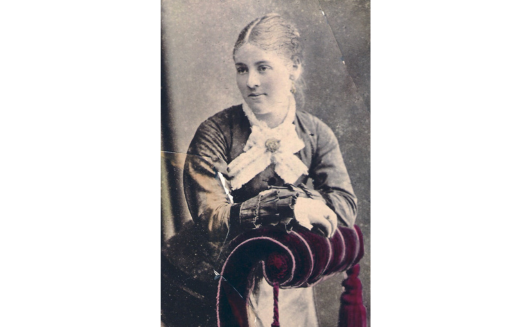
The photograph above is of my third-great-grandaunt Alice Grace Davies (née Rogers) and was likely taken between 1878-1888. Alice is quite unconventional in my family as she is the only ancestor I am aware of who was divorced. Understanding the social constructs around marriage and divorce is an important part of family history research - the “family” in Family Law is a compelling example of this. Divorce in particular has a complex and contested history, and the options and opinions around divorce vary significantly depending on the location and time period. In this blog post, I’ll be taking you through my research process for situating Alice’s divorce in its historical context of late 19th century Australia. For this research project, I am using the“Newspaper & Gazettes” database on Trove, the National Library of Australia’s extensive online repository for all things relating to Australian history.
My main source for Alice’s divorce is a lengthy divorce record from the Supreme Court of the Colony of Victoria in 1892, which reveals that Alice’s husband John Davies petitioned for (and was granted) a divorce from Alice owing to her affair with a man named William Douglass. It is impossible to definitively know what motivated Alice to have an affair, but the divorce record suggests that she was deeply unhappy in her marriage. Divorce would have also significantly shaped Alice’s life and the lives of her seven children, including her twin daughters who are of uncertain paternity according to the divorce record, and another daughter born nearly nine months after the divorce, with John Davies registered as the father.
To begin my Trove research, I extensively searched for both Alice and John’s names, but only found two 1892 newspaper reports that confirm John’s petition for a divorce was granted. This was a significant challenge with this research project, as I had hoped to find more information on Trove about Alice, John, and the children from after the divorce to see how it might have affected them. To get a sense of what material about divorce was available, I initially searched for Victorian newspapers and gazettes between 1888-1893 using the phrase “divorce.” There were 17,264 total results, which suggests that some kind of change or event around divorces was happening. After saving several relevant items, I realised that to get results closer to Alice’s context, I needed to narrow my search and decided to focus on Victorian divorces from June 1892 (when Alice’s divorce was published) to see if Alice’s divorce had parallels to other contemporary divorce cases. This gave 351 results. I considered narrowing the parameters again to newspapers from where Alice and John were living but realised that might restrict the scope too much, so instead I focussed on divorce cases from the Argus, a widespread Victorian newspaper that published one of Alice’s divorce notices. This gave a manageable 47 results. Overall, the reports I read suggest that divorce on the grounds of adultery was common among men and women, but that more women sought divorces than men. The majority of cases I read were granted a decree nisi, meaning that the marriage will end unless disputed or the petition proved invalid within three months, indicating that divorce was certainly possible for both women and men like John at this time.
I then searched Trove to see whether the original 17,264 results were influenced by any legal changes and found that divorce law was heavily debated and changing in the 1880s and 1890s, centred on the new Divorce Amendment Act (also referred to as Shiels’ Divorce Act and The Divorce Bill). The Act made it much easier for poorer people to get a divorce and expanded the grounds upon which it could be granted, but did face staunch opposition before being given Royal Assent in 1890. Although a wife’s adultery was already established grounds for divorce, the Act demonstrates the diversity of public opinion around divorce that would have influenced Alice, John, and the children’s social experiences as a divorced family. Although Alice was not the petitioner for her divorce, by having an affair she automatically subverted 19th century expectations of women, so I was interested to see how divorce fitted into the wider context of women’s rights during the 1880s and 1890s. I found several intriguing articles, including one that debated whether marriage was actually beneficial for women.
Overall, my research findings indicate that in late 19th century Victoria, both men and women like Alice and John were frequently granted divorces under a variety of grounds, with changing legal and social attitudes toward the topic. My next project will be to research what happened to Alice and her children after John divorced her, and how the social constructs, beliefs, and opinions surrounding acceptable female behaviour may have affected her as a woman divorced by her husband for adultery.
If you would like to view the list of Trove newspaper articles that I saved about this topic, you can do so here: https://trove.nla.gov.au/list/181439.
Best wishes,
Liliana.
_________________________
BIBLIOGRAPHY
PRIMARY SOURCES
‘A Woman’s View of Divorce’, Herald (Melbourne), 21 June 1890, p. 2, http://nla.gov.au/nla.newsarticle242106743.
‘Law Report [Davies v Davies]’, Argus, 14 June 1892, p.3, http://nla.gov.au/nla.newsarticle8429423, accessed 7 September 2024.
‘Law Report. Divorce and Matrimonial Causes’, Argus, 15 June 1892, p. 6, http://nla.gov.au/nla.news-article8429848, accessed 7 September 2024.
‘Law Report. Divorce and Matrimonial Causes’, Argus, 27 June 1892, p.3, http://nla.gov.au/nla.news-article8433873, accessed 7 September 2024.
‘Law Report. Divorce Court’, Argus, 10 March 1891, p. 4, http://nla.gov.au/nla.news-article8482143, accessed 7 September 2024.
‘Melbourne (From Our Own Correspondent) Monday’, Geelong Advertiser, 14 June 1892, p.3, http://nla.gov.au/nla.news-article149930220, accessed 7 September 2024.
‘Operation of The Shiels’ Divorce Act;, Ballarat Star, 16 June 1892, p.4, http://nla.gov.au/nla.newsarticle204983348, accessed 7 September 2024.
‘The Divorce Amendment Act’, Warragul Guardian and Buln Buln and Narracan Shire Advocate, 20 May 1890, p. 3, http://nla.gov.au/nla.news-article70810415, accessed 7 September 2024.
‘The Divorce Bill’, Argus, 13 December 1889, p. 4, http://nla.gov.au/nla.news-article8578569, accessed 7 September 2024.
‘The Divorce Bill’, Ballarat Star, 13 July 1889, p. 2, http://nla.gov.au/nla.news-article209454846, accessed 7 September 2024.
‘The Question of Divorce’, Avoca Mail, 28 June 1892, p. 3, http://nla.gov.au/nla.newsarticle202117807, accessed 7 September 2024.
Birth registration of Maude Grace Davis [Davies], born 4 March 1893, Registry of Births, Deaths and Marriages, Victoria, 584 / 1893.
Davies v Davies v Douglass [1892], divorce record, Victoria, Australia, Public Records Office Victoria (PROV), VPRS 283/P0000, 1892/27, in Victoria, Australia, Divorce Records, 1860- 1940, Ancestry.com, accessed 7 September 2024.
Photograph of Alice Grace Davies (née Rogers), undated (c.1878-1888), current holder unknown (digital copy held by author).
Pollex, ‘The Ladies Page. The Marriage Question’, Australasian Sketcher with Pen and Pencil, 27 December 1888, p. 203, http://nla.gov.au/nla.news-article63225022, accessed 7 September 2024.
SECONDARY SOURCES
Bowes, Julia, ‘Family’, in The Routledge Global History of Feminism, by Bonnie G. Smith and Nova Robinson (eds), Routledge, London, England, 2022, pp. 533-546
Griffith, R. G. De B., 'à Beckett, Sir Thomas (1836–1919)', Australian Dictionary of Biography website, first published in hardcopy 1969, https://adb.anu.edu.au/biography/a-beckett-sirthomas-2860/text4073, accessed 7 September 2024.
Kha, Dr Henry, and Sarah Maguire, ‘'Til death – or adultery – do us part: the bad old days of divorce’, Macquarie University, The Lighthouse website, 10 March 2021, https://lighthouse.mq.edu.au/article/march-2021/Til-death-or-adultery-do-us-part-the-badold-days-of-divorce, accessed 7 September 2024.
Lorimer, Catherine, ‘Reform of family law’, Parliament of Australia website, https://www.aph.gov.au/About_Parliament/Parliamentary_departments/Parliamentary_Librar y/pubs/BriefingBook46p/FamilyLaw, accessed 7 September 2024.
Phillips, Rod, ‘When did humans start getting divorced?’ [YouTube Video], TED-Ed, YouTube, 29 January 2021, https://youtu.be/Zj089JLYdMA?si=62Xm6FM3D41h49Z1, accessed 7 September 2024.
Public Record Office Victoria, ‘Divorce’, Public Record Office Victoria website, https://prov.vic.gov.au/archive/VF276, accessed 7 September 2024.
Public Record Office Victoria, ‘Index to Divorce Cause Books’, Public Record Office Victoria website, https://prov.vic.gov.au/archive/VPRS5335/about, accessed 7 September 2024.
Public Record Office Victoria, ‘Supreme Court of Victoria’, Public Record Office Victoria website, https://prov.vic.gov.au/archive/VA2549, accessed 7 September 2024.
Research Data Australia, ‘AGY-1059 | Matrimonial Causes Division (1873-1972) / Divorce Division (1972-1973) / Family Law Division (1973-1977) [Supreme Court of New South Wales]’, Research Data Australia website, https://researchdata.edu.au/agy-1059-matrimonial-southwales/164902#:~:text=Full%20description,the%20restitution%20of%20conjugal%20rights., accessed 7 September 2024.
Serle, Geoffrey, 'Shiels, William (1847–1904)', Australian Dictionary of Biography website, first published in hardcopy 1988, https://adb.anu.edu.au/biography/shiels-william-8418/text14787.
Trove, ‘The Argus (Melbourne, Vic. : 1848 - 1957)’, Trove website, http://nla.gov.au/nla.newstitle13, accessed 7 September 2024.