
Affordable family history #1
The ongoing cost of living crises have made researching family history inaccessible for many. I believe that everyone should have access to the tools to research their family tree, no matter their financial situation. In this three part series, I'll be sharing tips and tricks for researching family history for free or at a lower cost.
Today, let's look at how to use the information found in index search results.
Purchasing a certificate of birth, death, marriage (or another event) can be expensive. While these records are often crucial in tracing a family line or filling in missing information, you can sometimes get by with studying the search results (AKA the index). To help you identify the record you want to purchase, sites usually list the event's year, where it took place, and most importantly, the key names on the record. Let's take a look at a search I just did for an ancestor's birth certificate on the ScotlandsPeople website (scotlandspeople.gov.uk)
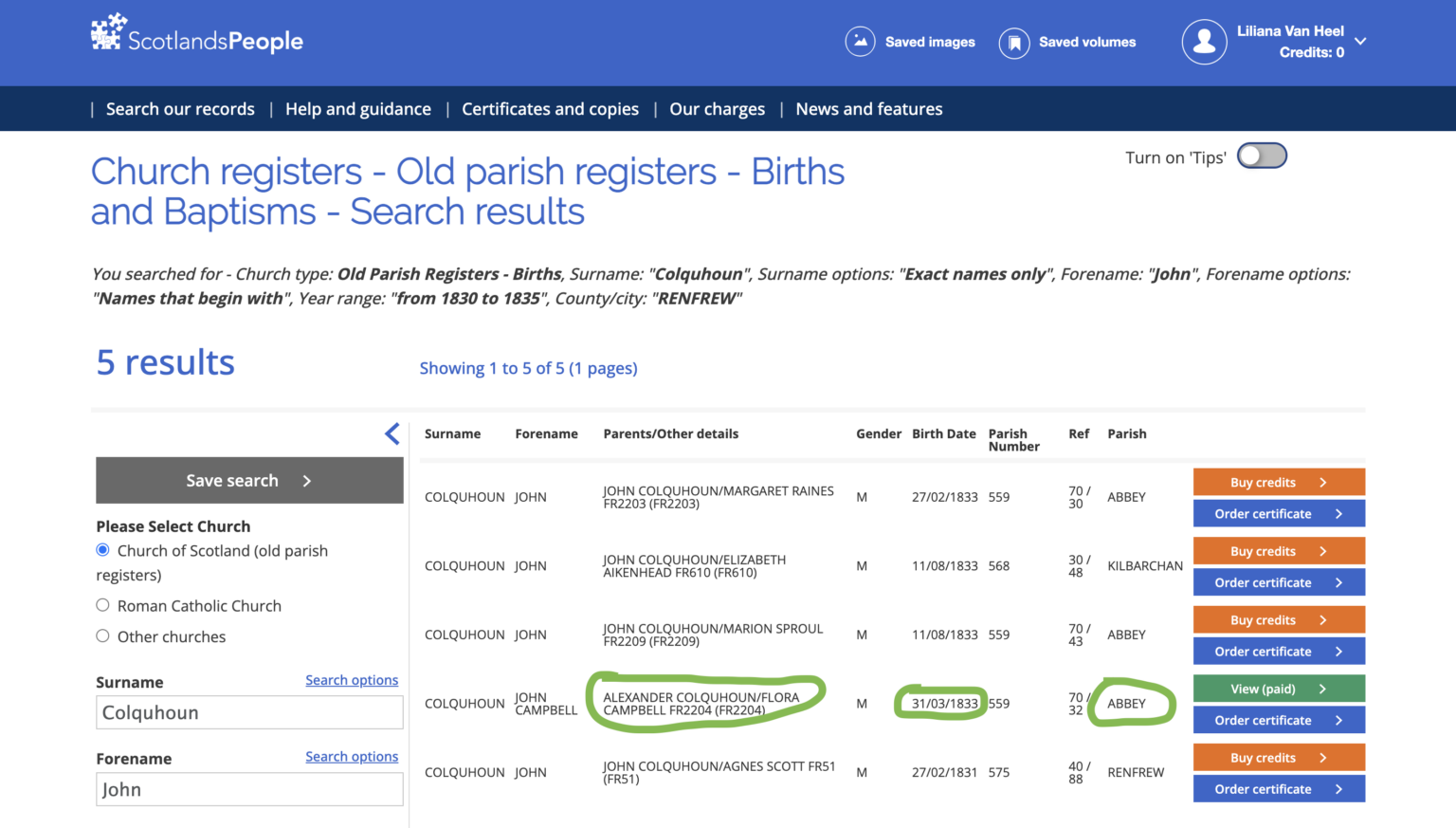
As you can see by the green circles I drew around the matching record, there is a wealth of information available just via these search results alone.
Let's take a closer look.

The index entry shows several pieces of key information. Firstly, my ancestor's surname, Colquhoun, and then his forename, John, and his middle name, Campbell. Next, the record lists his parents, Alexander Colquhoun and Flora Campbell.
Next we see his gender, M (male), the date, 31/3/1833 (which can mean the date of birth or date of baptism/registration) and the location, Abbey (sometimes known as Abbey Paisley), Renfrewshire, Scotland. Now, this is where index entries can sometimes become a bit unreliable. I purchased a copy of this record a few years ago, and on viewing the record, some of the info varies from the search results entry. Firstly, his birth date is actually 31/5/1833. This is explained by the ledger page titled "March" but, the record keeper used the same page for births that occurred in some of March, then April and May and marking where the new month starts on the left side of the page.
Next, the location is a little off. The record states that he was born in Williamsburgh (Renfrewshire, Scotland), not Abbey. While the whole births ledger is not available for me to view, I suspect that Abbey was where John's birth was registered, and that's why it is listed in the search results.
Some other information that viewing the actual record provides is that John's father Alexander, was a weaver, and given that Williamsburgh was a village in near Paisley indicates that Alexander (and likely Flora too) worked as paisley fabric weavers, which Renfrewshire is historically known for.
When I work with information from indexes/search results in my own family tree, I like to treat them with a grain of salt and use the general date and location as opposed to the specifics. For example, had I not purchased John's record and was working exclusively with the search results, I would list him in my family tree as being born in 1833, Renfrewshire, Scotland, and then in the notes section (either general notes or event specific notes in the family tree profile) list the specific date and location from the search results for cross-referencing later on.
Overall, viewing a copy of an original birth/marriage/death/other primary source record is a necessary and often vital part of family history research, especially when tracing difficult lines of your tree. But, indexes/search results can offer a fantastic starting point if purchasing the full record/certificate is not possible at the moment.
Best wishes,
Liliana